Federal Office for the Environment FOEN

This version is for browsers with a low level of support for CSS.

Home Language Selection


Home Content Area

Home Navigator

End Navigator


Drinking water from the forest

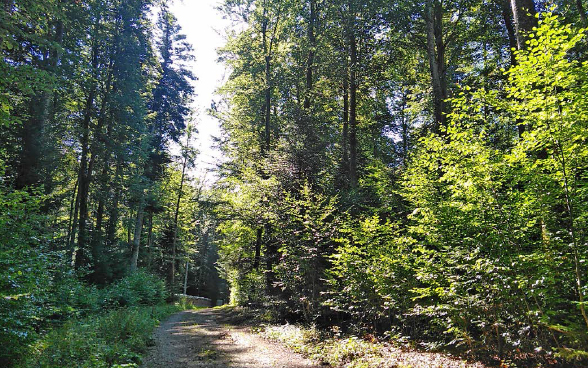
Ground water from forest catchment areas is generally so pure that it can be used directly as drinking water without treatment. The FOEN’s aim is to preserve the filtering capacity of forests in the long term. In catchment areas, drinking water protection should be prioritised above all other forest uses. This requires closer cooperation between forestry operators and water supply services.


 PDF
Wälder liefern das beste Trinkwasser
Schürch M., Herold T. und Kozel R. (2003). Bündner Wald Nr. 4/2003, 71-76.
14.03.2008 | 987 kB | PDF


2. The filtration effect of forest soils

Ground water from forest catchment areas is generally so pure that it can be used directly as drinking water without treatment. The natural filtration effect of forest soils with good cover, root systems and microbial activity ensures that the water quality is generally excellent. The absence of ploughing also contributes to this reliable filter function. Ground water from largely forested catchment areas therefore generally has low levels of nitrates and chlorides, contains hardly any pesticides, few cloudy substances and scarcely any unwanted pathogens. The karst regions of the Jura form an exception, where the seepage water flows rapidly through the deeply fissured ground. Quality problems can also occur on acid soils - as in the Ticino - or in the flysch regions of the lower Alps.

Further information:

 PDF
Der Wald sorgt für sauberes Trinkwasser
Artikel in der Fachzeitschrift gwa - Gas Wasser Abwasser, 3/2003
17.03.2008 | 251 kB | PDF

Der Waldboden – ein optimaler Filter - Artikel im Magazin UMWELT 3/2005

3. Few contaminants in the forest

As opposed to areas with intensive agricultural use, there is very little direct deposition of environmentally hazardous substances on forest soils. The use of fertilizers such as chemical fertilizers, liquid manure, manure, compost or sewage sludge is either prohibited or greatly restricted. In addition, the use of chemical substances is only allowed in certain circumstances - for example for protecting felled commercial timber from bark beetle infestation.

Outside populated areas there are very few sewage pipes in the forest, which could leak faecal bacteria and other unwanted contaminants into the ground water. Furthermore, the risk of accidents involving substances harmful to water, such as fuels or chemicals, is considerably lower in the forest, as is the risk of negligent handling. All these factors have a positive influence on the quality of drinking water from forested catchment areas.

Further information:

 PDF
Grundwasser
Qualitäts-Lebensmittel aus dem Waldboden
18.03.2008 | 114 kB | PDF

Artikel im Magazin UMWELT 1/2003
 PDF
Schutz und Nutzung von Grundwasser im Wald
Artikel PUSCH, Thema Umwelt 4/2003
17.03.2008 | 1352 kB | PDF


4. The forest offers the best protection

Particularly in regions with intensive agricultural activities subject to considerable nitrogen leaching, ground water frequently has excessive nitrate levels. In exceptional cases nutrient concentrations in the drinking water has can exceed the tolerance limit of 40 milligrams per litre laid down in foodstuffs legislation. 

High nitrate levels are frequently an indicator of pollution of the water by other contaminants such as pesticides. Depending on the ground water seep velocity, these problematic long-lasting pollutants can appear in the drinking water supply even years after they were applied.

As a result of limited commercial activities, springs and pumping stations in forests are less at risk from harmful substances than catchments in agricultural zones or in inhabited areas. The risk of diffuse pollution of drinking water in forests is therefore also considerably smaller.

Further information:

 PDF
5 Protection Forest
27.09.2006 | 807 kB | PDF


5. An exceptionally high number of ground water protection zones in the forest

In order to preserve the drinking water from pollution by contaminants and pathogens the water supply services have to protect the immediate surroundings of their springs and pumping stations by defining ground water protection zones. The nearer the catchment area, the more strict are the regulations in these graduated protection zones.

Based on the information from twenty cantons, the FOEN estimates the total area of ground water protection zones in Switzerland at 2,700 square kilometres, with 42% in areas with closed forest cover, corresponding to over 9% of Swiss forests. This is well over the proportion of the Swiss forest area, which amounts to 27% of the total land area, excluding copses and brushland.

In the densely populated cantons of the Swiss Plateau (Zurich, Berne, Aargau and Vaud) the ratio between the percentage of ground water protection zones in the forest and the percentage of forest area in the region is particularly striking. This demonstrates the high significance of the forest for the supply of high quality drinking water.

Further information:


6. Cheap drinking water from the forest

In Switzerland the approximately 3,000 public water supply services produce well over 1 billion cubic metres of drinking water. Some 83%comes from ground water reserves - the rest is treated lake water. Approximately 400 million cubic metres of the total domestic production can be fed directly to consumers without any form of treatment.

With average treatment costs of around 20 centimes per cubic metre the use of this pure ground water means savings in production costs for the waterworks of some CHF 80 million per year.

A large proportion of the water which can be consumed without any treatment comes from catchments in forested areas. Furthermore, drinking water from springs and ground water pumping stations with single-phase sterilisation benefit in qualitative terms from the forest. This assures a cheap, high quality, water supply.  

Further information:

 PDF
Wälder liefern das beste Trinkwasser
14.03.2008 | 511 kB | PDF


7. Forestry operations and ground water protection

By implementing near-natural silviculture, forestry operators can contribute to the high quality of the ground water from forest catchments. In this context the composition of tree species, age of the stand, forest management techniques used, harvesting procedures and handling of fuels which are harmful to water are particularly relevant.

In catchment areas of important springs and ground water streams, protection of groundwater should take priority over all other forest uses in forest planning.

Further information:


8. The threat of nitrate loading

The deposition of atmospheric nitrogen compounds in forests has trebled since the 1950s. Today, precipitation results in annual nitrogen loading of 20-40 kg per hectare of forest. The main causes of this eutrophication are transport and agriculture.

In time, this contamination can lead to leaching of important minerals and trees are exposed to a one-sided nutrient balance which can have negative effects on the root system, among other things. This can increase the occurrence of wind throw, desiccation, disease and parasites. Acidification also increases the risk of nitrate and contaminant loading of ground water in forest catchment areas. The higher the acidity of forest soils, the higher the concentration of aluminium, iron and manganese in seepage and surface waters.

In order to preserve the high quality of forest waters in the long term, effective measures to reduce the high nitrogen load are therefore necessary.

Further information:

 PDF
Auswirkung erhöhter Stickstoffbelastung auf die Stabilität des Waldes
Institut für Angewandte Pflanzenbiologie, Schönenbuch. 2011. Im Auftrag des BAFU.
08.03.2011 | 1938 kB | PDF

Institute for Applied Plant Biology (externer Link, neues Fenster) - Stickstoffbelastung, Bodenversauerung, Wurzeln


Contact: wald@bafu.admin.ch
Last updated on: 11.01.2013

End Content Area

Full-text search

Further information

The Franco-Swiss Interrog project ALPEAU is dedicated to the study of the interactions between forests and drinking water and includes drawing up  proposals to improve forest management practices, as well as testing partnerships between forestry operations and drinking water suppliers.


Federal Office for the Environment FOEN
info@bafu.admin.ch | Legal framework
http://www.bafu.admin.ch/wald/01198/01208/index.html?lang=en