

2030 reduction target (for the years 2021 to 2030)
Switzerland has committed to reducing its greenhouse gas emissions by at least 50 per cent by 2030 compared to 1990 levels. To this end, Switzerland is implementing climate protection measures both at home and abroad.
Signatories to the Paris Agreement have joined forces to limit global warming to well below two degrees Celsius. Under the agreement, they submit an updated reduction target every five years. Switzerland has committed to reducing its greenhouse gas emissions by at least 50 per cent by 2030 compared to 1990 levels. This target is implemented as an average reduction of at least 35 per cent over the years 2021 to 2030. The greenhouse gas balance of land use (vegetation, soils) as well as international attestations are taken into account. The target is anchored at international level in the Paris Agreement as the First Nationally Determined Contribution (NDC). The CO2 Act transposes this target into national law and defines the measures necessary for its implementation.
The 2030 target is an important intermediate step; Switzerland will continue its commitment beyond this date. It has defined and legally enshrined further targets in the Climate and Innovation Act and the Second Nationally Determined Contribution:
Review of the 2030 target (for the 2021–30 period)
Switzerland’s greenhouse gas inventory forms the basis for defining and reviewing reduction targets. Emissions from all sectors are considered, in particular also the greenhouse gas balance of land use (vegetation, soils) across the entire country. However, in accordance with international regulations, emissions from international aviation and navigation are not taken into account.
The annual reduction target of at least 50 per cent by 2030 compared to 1990 is consistent with the average target of a reduction of at least 35 per cent over the years 2021 to 2030. The data is not adjusted for weather conditions in the target achievement review. Consequently, the average target plays an important role, as it averages out annual fluctuations in emissions.
Overall target
The following chart compares Switzerland’s total greenhouse gas emissions with the targets set for the years 2021 to 2030. Measures taken abroad are not yet taken into account here.

Domestic share
At least two thirds of the reductions required to achieve the reduction targets must be made in Switzerland. The remainder can be achieved through measures taken abroad. Emissions from the building, transport and industry sectors, as well as other greenhouse gas emissions where climate policy measures have a direct impact on emission trends, are considered when calculating the domestic share. The greenhouse gas balance of land use is not taken into account for the domestic share. By 2030, relevant emissions must be reduced by at least one third compared to 1990 levels (corresponding to two thirds of the 50 per cent reduction).

Reference values for individual sectors
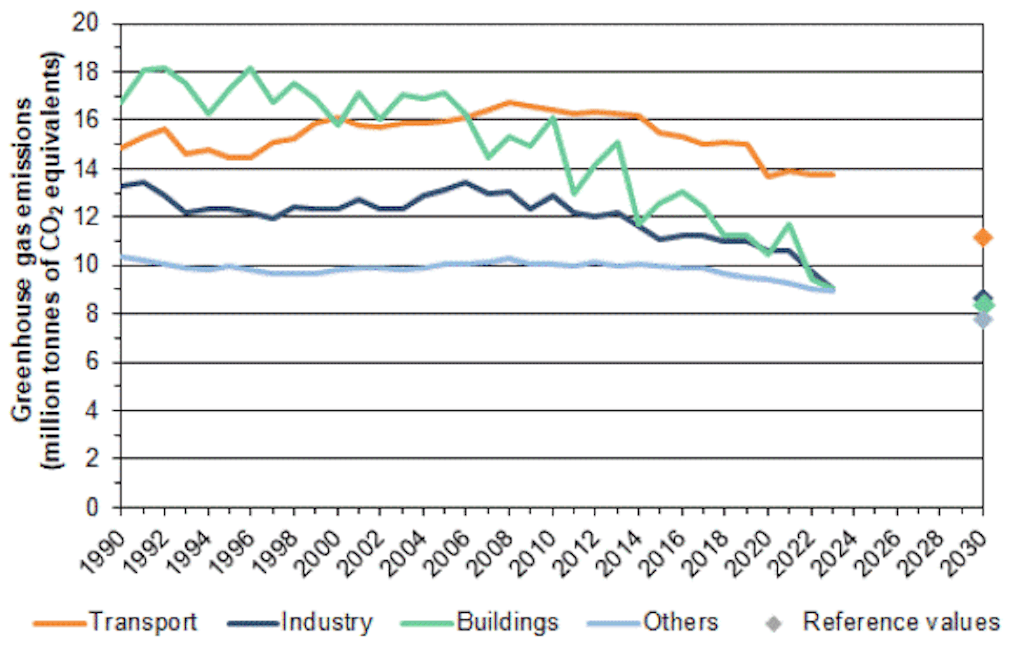
The CO2 Ordinance defines reference values for individual sectors for the maximum permissible emissions in 2030 relative to emissions in 1990:
- Buildings: maximum 50 per cent
- Transport: maximum 75 per cent
- Industry: maximum 65 per cent
- Other: maximum 75 per cent
Transitional arrangements up to the end of 2024
Because voters rejected the total revision of the CO₂ Act for the period up to 2030 on 13 June 2021, Parliament decided a transitional arrangement. This required greenhouse gas emissions to be reduced by a further 1.5 per cent annually compared to 1990 level by 2024. At least 75 per cent of the reduction had to be achieved by domestic measures.
Further informations
Index
Sector Climate
Sector Climate
Worblentalstrasse 68
3063 Ittigen