

Aquatic life at risk
Intensive use and hard engineering of water bodies as well as pollutant input are affecting many animals and plants that live in and around water. Climate change is placing added pressure on the water bodies due to higher water temperatures and changes in runoff. This will lead to a decline in biodiversity in and around waterbodies.
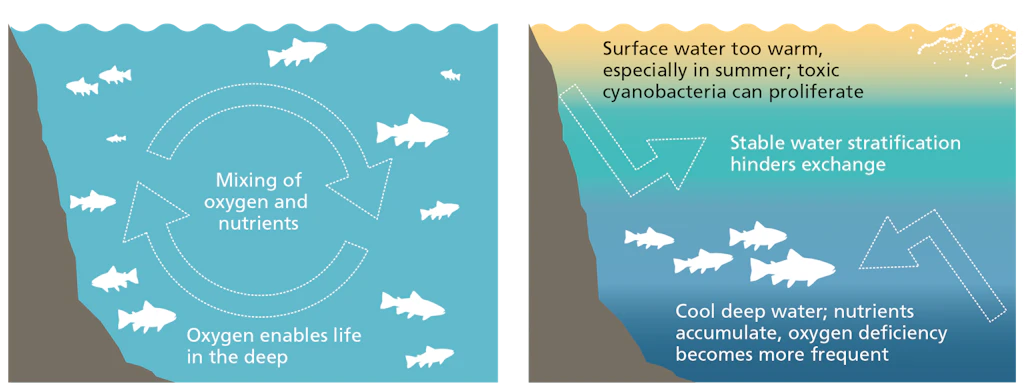
Effects of global warming on lakes
Not all aquatic life can adapt
Some aquatic organisms will be able to adapt to climate-related changes by moving to cooler waters, mostly at higher elevations. However, this will only be possible if there are no obstacles in their way, such as hydropower plants or weirs. Moreover, the new environment must be suitable for them. For example, the temperature of mountain streams would be ideal for grayling, but this species would be unable to cope with the strong currents.
Overall native biodiversity in and around water is already under severe pressure. The risk to diversity extends beyond fish and crustaceans, which are among the most threatened species in Switzerland.
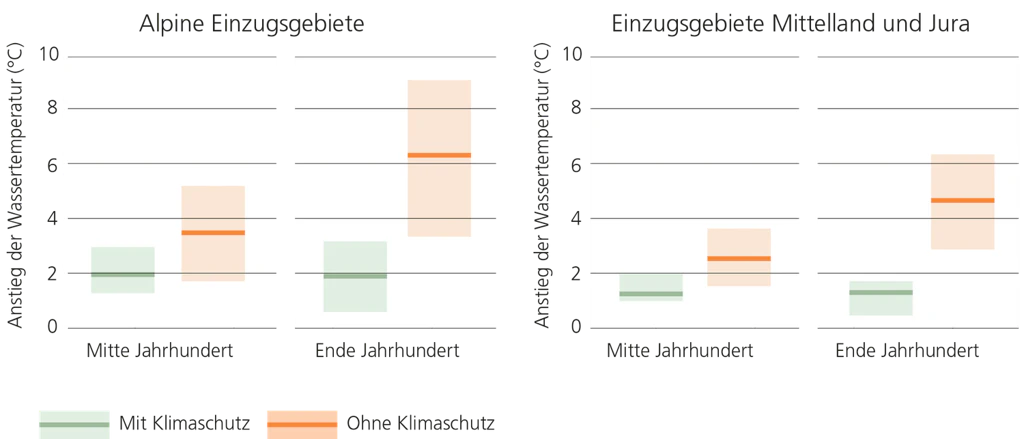
Water temperatures in watercourses
Winners and losers
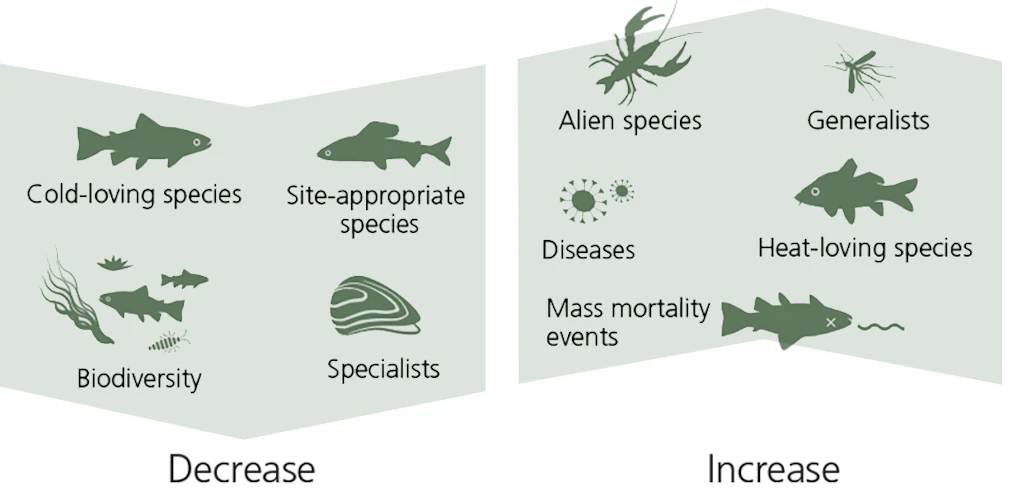
Expected changes
The key messages can also be found in the Hydro-CH2018 brochure, which is available in printed form or electronically as a download.