

Extinguishing agents
Extinguishing agents include here fire-fighting foam concentrates (extinguishing agents containing fluorinated surfactants) as well as ozone-depleting extinguishing agents and extinguishing agents stable in the atmosphere. Fire-fighting foam concentrates are subject to Annex 1.16 of the Chemical Risk Reduction Ordinance (ORRChem). Ozone-depleting extinguishing agents and extinguishing agents stable in the atmosphere are regulated by Annex 2.11 of the ORRChem.
1. Foam extinguishing agents (extinguishing agents with fluorinated surfactants)
In the past, many fire-fighting foam concentrates contained fluorinated surfactants, or per- and polyfluoroalkyl substances (PFASs) and some still contain them today. The manufacture, placing on the market and use of fire-fighting foam concentrates containing perfluorooctane sulfonic acid (PFOS) and its derivatives, perfluorooctanoic acid (PFOA), perfluorocarboxylic acids with 9 to 14 carbon atoms (C9–C14 PFCAs) and perfluorohexane sulfonic acid (PFHxS) or their respective precursors are prohibited if the substances exceed certain mass concentrations (see Annex 1.16 ORRChem). Further information on the regulation of individual PFASs can also be found on the FOEN website under the topic legal basis for PFASs.
PFASs – what are they? (available in German, French and Italian)
The Federal Council has also proposed to restrict the placing on the market of PFAS-containing fire-fighting foam concentrates in fire extinguishers and use of all PFAS-containing fire-fighting foam concentrates for all applications, similar to what has been decided in the EU. In order to assess the impact of such a regulation on stakeholders in Switzerland, the current state of knowledge on the use of fire-fighting foam concentrates in Switzerland was compiled on behalf of the FOEN. The report is available in German and French.
In addition, the Federal Council has proposed to align the permitted mass concentrations in preparations containing PFOS and its derivatives with those of the EU. These changes would also affect fire-fighting foam concentrates. The existing and planned regulations on fire-fighting foam concentrates are also shown again graphically in the document “Overview of the regulations on foam extinguishing agents in the ORRChem”.
2. Ozone-depleting extinguishing agents
Extinguishing agents that contain substances that deplete the ozone layer in accordance with Annex 1.4 ORRChem are regarded as ozone-depleting extinguishing agents (Annex 2.11, number 1, paragraph 1, ORRChem). These include, for example, halons such as bromotrifluoromethane (Halon 1301) or bromochlorodifluoromethane (Halon 1211), which have very high ozone depleting potentials.
Substances that deplete the ozone layer
Prohibitions
Since 1 January 1992, the placing on the market, including the import, of ozone-depleting extinguishing agents and of equipment or systems containing such extinguishing agents has been prohibited (Annex 2.11, number 2.1 ORRChem).
Since 1 June 2024, there has also been a ban on the use of ozone-depleting extinguishing agents (Annex 2.11, number 4.1, paragraph 1 ORRChem). Systems containing extinguishing agents that deplete the ozone layer (e.g., halons) had to be taken out of service before this date and the extinguishing agent contained had to be disposed of or recycled properly.
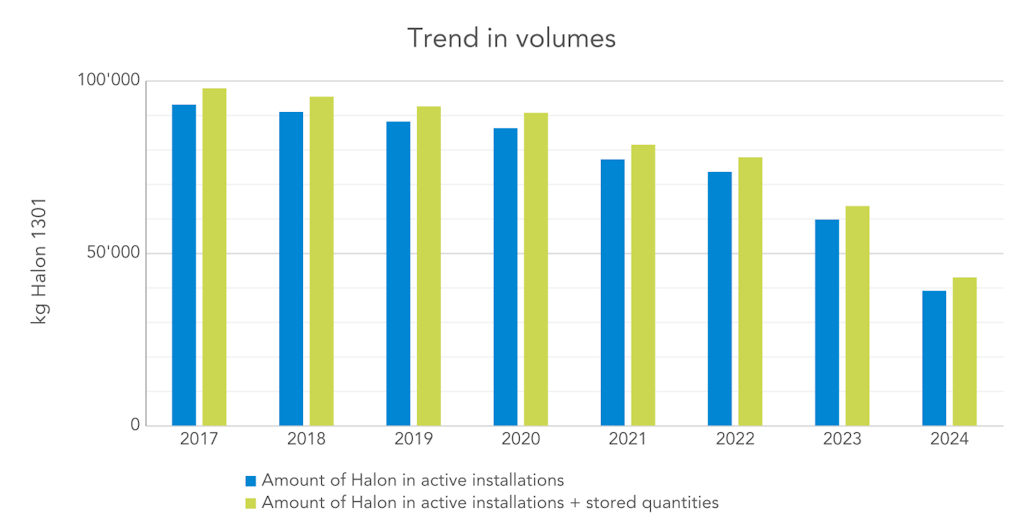
The ban on the use was decided in order to reduce the risk of leaks in systems that still contain ozone-depleting extinguishing agents. Although the installed quantity of ozone-depleting extinguishing agents had decreased significantly since the ban on placing on the market entered into force in 2017, about a quarter of the quantity reported in 1992 was still present in systems. The risk of leaks and thus damage to the environment rises increasingly with the ageing of systems and the decreasing availability of spare parts for maintenance. Since the ban on the use was announced in 2019, the quantities installed have fallen by about half.
Exceptions
Exceptions to the above-mentioned prohibitions exist for the use in aeroplanes, special-purpose military vehicles or nuclear installations, if the safety of persons cannot be adequately ensured in accordance with the current state of the art in fire prevention without the use of ozone-depleting extinguishing agents (Annex 2.11, number 2.2, letter d and paragraph 4.2 ORRChem).
Servicing
Owners of appliances or systems according to Annex 2.11, number 1, paragraphs 3 and 5 ORRChem that contain ozone-depleting extinguishing agents and benefit from the above-mentioned exemptions must have these serviced by a specialist regularly (Annex 2.11, number 6.2 ORRChem):
- Appliances: every three years
- Systems: annually.
3. Extinguishing agents stable in the atmosphere
Extinguishing agents stable in the atmosphere are extinguishing agents containing substances stable in the atmosphere in accordance with Annex 1.5 ORRChem (Annex 2.11, number 1, paragraph 2 ORRChem). These include, for example, pentafluoroethane (HFC-125) or heptafluoropropane (HFC-227), which have global warming potentials thousands of times higher than CO2.
Substances stable in the atmosphere
Prohibitions
Since 1 January 1996, the placing on the market of extinguishing agents stable in the atmosphere, which includes the import of the substances, and of appliances or systems containing such extinguishing agents has been prohibited (Annex 2.11, number 2.1 ORRChem). In addition, extinguishing agents stable in the atmosphere shall not be used in exercises and tests (Annex 2.11, number 4.1, paragraph 2 ORRChem).
Exceptions
An exceptions exists for the placing on the market of extinguishing agents stable in the atmosphere for the use in aeroplanes, special-purpose military vehicles or nuclear installations if the safety of persons cannot be adequately ensured in accordance with the current state of the art in fire prevention (Annex 2.11, number 2.2, letter d ORRChem). Additionally, there is an exception for the import of hand-held fire extinguishers for use in private vehicles (Annex 2.11, number 2.2, letter c ORRChem).
Servicing
Owners of appliances or systems according to Annex 2.11, number 1, paragraphs 3 and 5 ORRChem that contain extinguishing agents stable in the atmosphere must have these serviced by a specialist regularly (Annex 2.11, number 6.2 ORRChem):
- Appliances: every three years
- Systems: annually.