

Food waste and loss
When food is produced but not consumed, this leads to unnecessary CO2-emissions, biodiversity loss and land and water consumption. 25 per cent of the environmental impact of our food system is due to food waste (i.e. avoidable food losses). This corresponds to about half the environmental impact of motorized private transport in Switzerland. With the action plan to reduce food waste, the Federal Council wants to halve avoidable food losses by 2030 compared to 2017. This is in line with Sustainable Development Goal 12.3 of the 2030 Agenda for Sustainable Development.
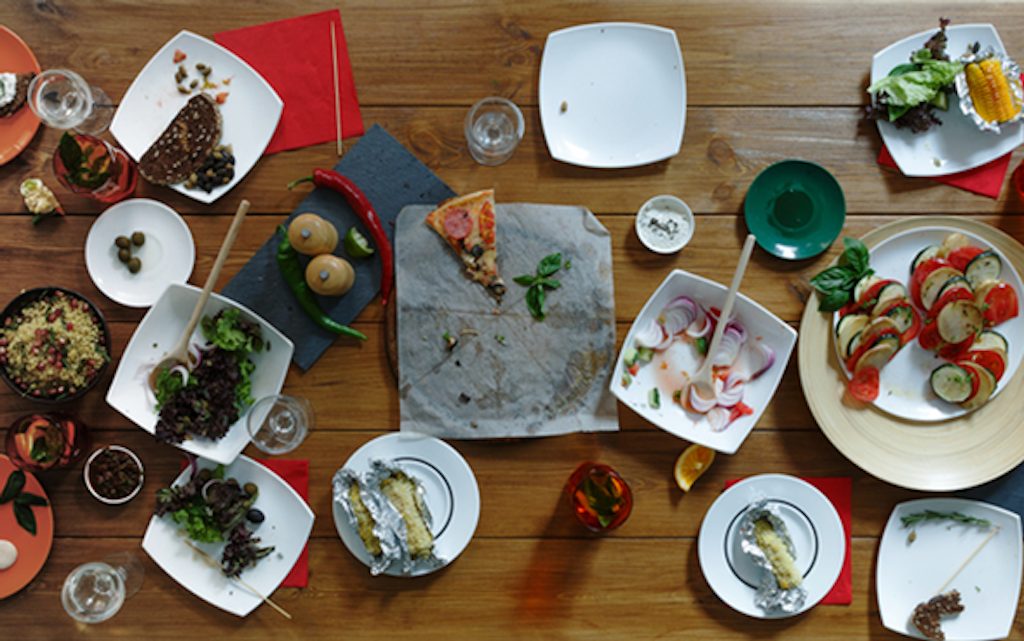
Avoidable and unavoidable food losses
Food waste and loss refer to all food intended for human consumption that is not consumed by humans.
Food waste is the term used to describe avoidable food loss. These are the edible portions of food that are produced for human consumption, but end up not being consumed by humans.
Unavoidable food losses are, for example, parts of food that are not edible or are considered inedible in our culture.
Swiss food losses from the field to the plate
Around one third of all edible food is lost between the field and the plate.
Food losses can be measured either from a consumption perspective (losses generated by food consumption in Switzerland, including imports and the associated losses generated abroad, but excluding export-related losses), or from a disposal perspective (food losses disposed of in Switzerland, including export-associated losses, but not including import-associated losses generated abroad, since these are not disposed of in Switzerland).
The FOEN bases its data on the ZHAW interim report (Beretta et al., 2025) and its predecessor study by Beretta and Hellweg, published by ETH Zurich (2019). According to these studies, food consumption in Switzerland results in a loss of around 2.8 million tonnes of food each year. This loss is incurred both in Switzerland and abroad (consumer perspective). The total amount is equivalent to 310kg of avoidable food loss per person per year over the whole value chain.
Of the 2.8 million tonnes, around 380,000 tonnes of food is lost abroad during the production of food imported into Switzerland. In addition, around 240,000 tonnes of avoidable food losses occur in Switzerland in the production of food for export. These losses are taken into account in the food disposal statistics, but not in the food consumption statistics (see table below).
The ZHAW interim report shows that food losses in Switzerland have been reduced by around 5% since 2017 and identifies action that could be taken to achieve the target of 50% by 2030.
Environmental impact due to avoidable food losses
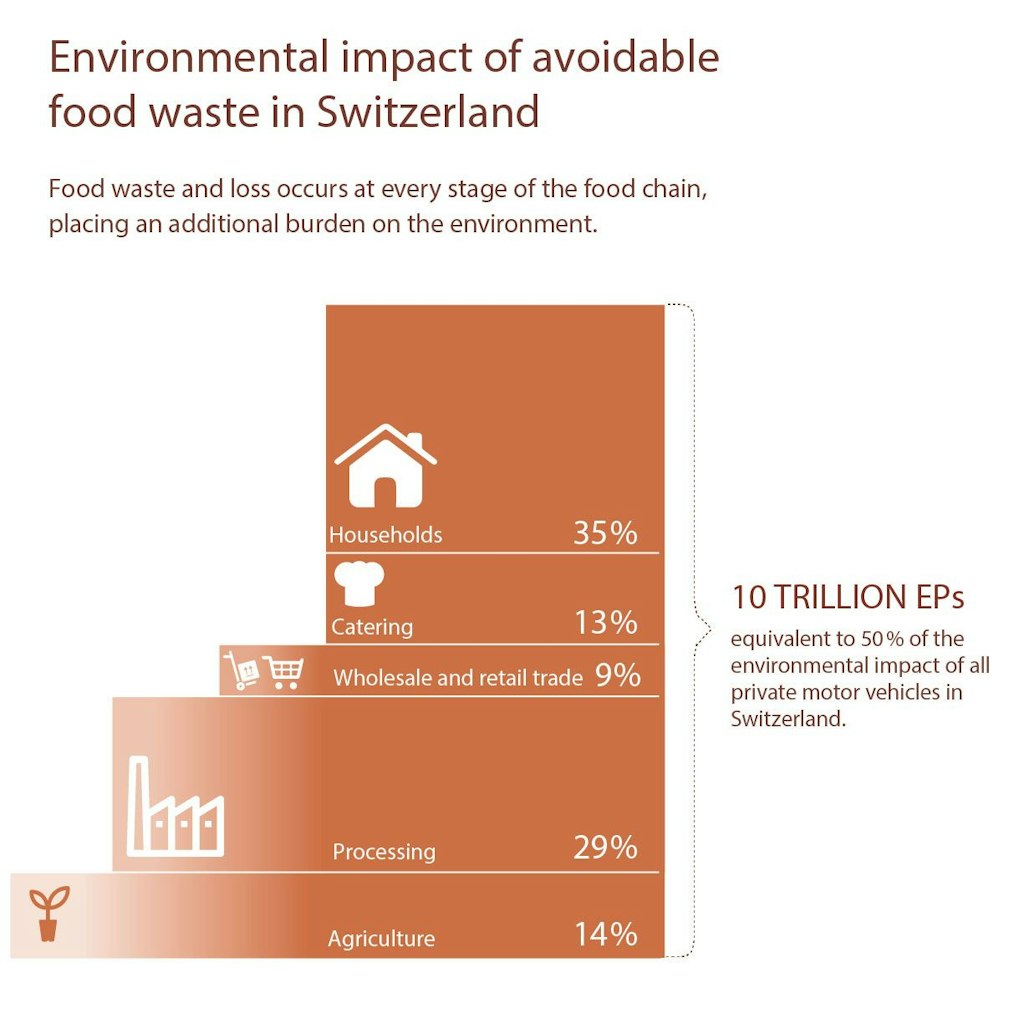
The food system amounts to around 28% of Switzerland's total footprint. A quarter of this is the result of avoidable food losses. The implementation of the halving target in Switzerland would reduce the environmental impact and greenhouse gas emissions of food by 10-15%.
The environmental impact of a tonne of food loss varies greatly depending on which products it is made up of and where in the value chain it occurs. Food loss should be avoided as a priority in the case of foods that have a particularly high environmental impact or are produced in large quantities. The food categories with the greatest environmental impact per kilogramme of food loss are meat, coffee and cocoa beans, butter, eggs, products imported by air, and oils and fats, fish and cheese. The losses of fruits and vegetables (including in particular potatoes) as well as breads and baked goods are also environmentally relevant, despite a lower environmental impact per kilogramme, because they occur in large quantities.
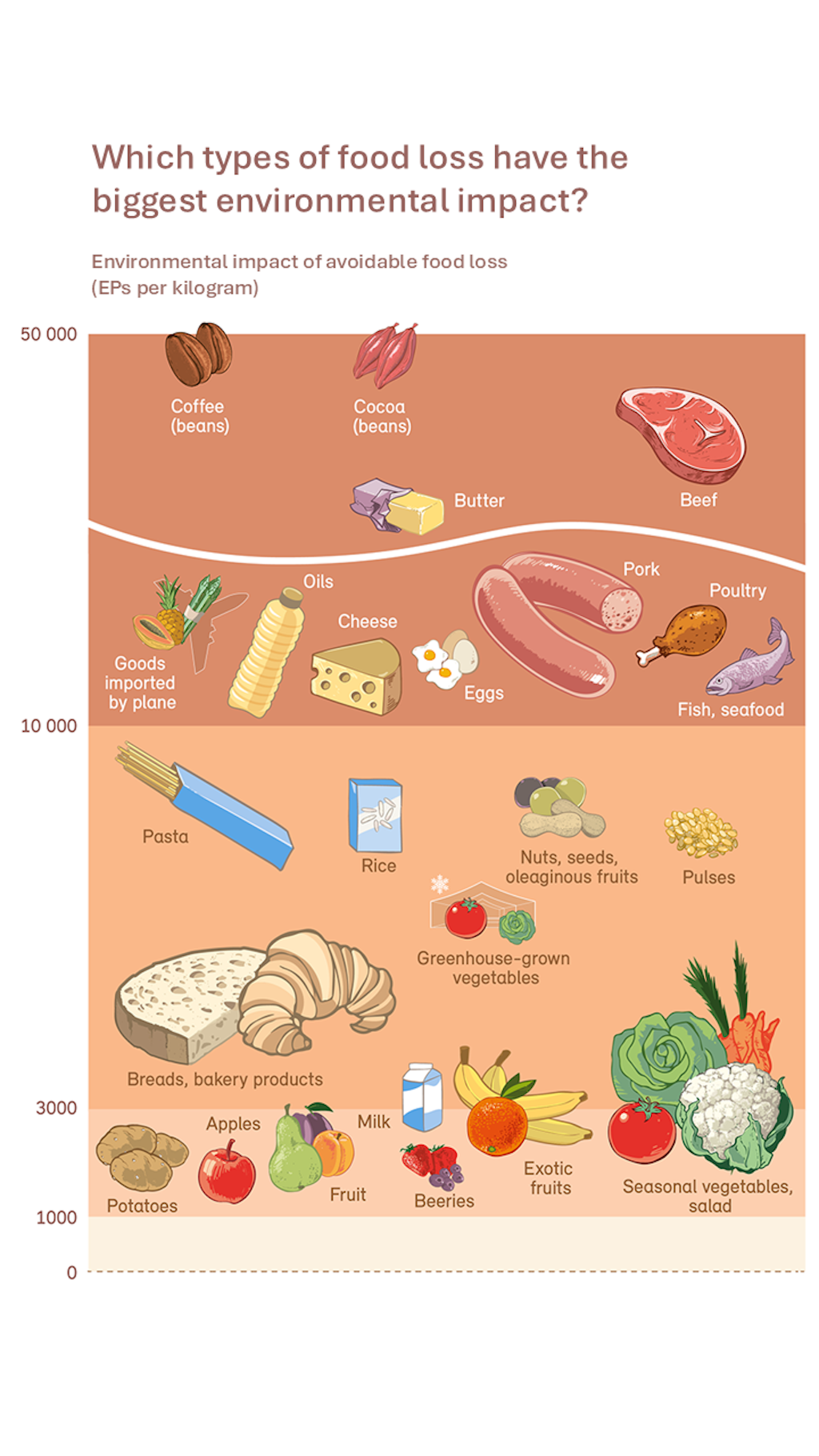
The environmental impact of a food product also increases with each stage of processing and/or transport, as these processes involve resource consumption and produce emissions. In addition, losses in the processing industry and to some extent in agricultural production tend to be recycled to a higher value (especially as animal feed) than at the other stages of the food chain. Environmental credits are granted for the substituted products (mainly animal feed).
Action plan to reduce food waste
On 6 April 2022, the Federal Council adopted an action plan against food waste, in response to the Chevalley Postulate 18.3829 (available in German, French and Italian). The action plan is addressed to all companies and organisations in the food industry along the supply and value chains, and to the federal government, cantons and municipalities. The action plan against food waste has three objectives:
1. Halving the amount of avoidable food losses in Switzerland by 2030 compared to 2017
2. Defining industry-specific reduction targets together with the industries
3. Reducing the environmental impact of avoidable food losses as much as possible through the appropriate formulation and prioritisation of measures
The action plan is divided into two phases. The first phase (2022-2025) comprises seven self-regulatory measures for the economy, five measures for the public sector and two measures on information and education. In 2025 the ZHAW published an interim report on behalf of the federal government. The design of the second phase builds on its findings and is set out in the Federal Council's interim report on the action plan against food waste (see press release with link to the Federal Council's interim report).
06.05.2026 – Zwischenbericht zum Aktionsplan gegen die Lebensmittelverschwendung
Cross-industry agreement on reducing food losses
The cross-industry agreement on reducing food losses is an important element of the action plan. The agreement creates a framework that enables a coordinated approach to the economy's implementation of self-regulatory measures, raising awareness of positive examples, and striving for and communicating cross-industry progress. By signing the agreement, the parties commit to halving avoidable food losses by 2030. The companies and associations from trade, catering, processing and agriculture will set measurable reduction targets and take appropriate measures for each stage of the value chain. All parties to the agreement will report annually on avoidable food losses and the measures they are taking to reduce them. The FOEN will regularly provide information on the participants' joint reductions.
The agreement was signed on 12 May 2022 by Federal Councillor and DETEC head Simonetta Sommaruga and 28 members of management from companies and associations in the Swiss food sector. On 14 October 2025, Federal Councillor Albert Rösti discussed the form that the second phase of the action plan will take at a meeting with the signatories and other major players
Other companies and associations in the food industry can sign the cross-industry agreement at any time. Would you like to help cut avoidable food losses? Then get in touch with us (see contact box at the top right).
Further Information
Index
Federal Office for the Environment FOEN
Economics and Innovation Division
Mühlestrasse 2
3063 Ittigen