

Greenhouse gas emissions from agriculture
The Agriculture sector shows the greenhouse gas emissions from livestock, fertiliser use and energy consumption. These mainly consist of methane (CH4) and nitrous oxide (N2O). Carbon dioxide (CO2) emissions result from the use of fossil fuels and from lime and urea fertilisers. They make a smaller contribution to greenhouse gas emissions in the Agricultural sector.
In terms of total CH4 and N2O emissions, the Agriculture sector is way ahead of all the other sectors. The CH4 emissions in the Agricultural sector are mainly due to cattle rearing and the use of farmyard manure. The N2O emissions primarily come from agricultural land and, to a lesser extent, from farmyard manure use. On agricultural land, N2O is released through the biodegradation processes of nitrogen inputs (commercial fertiliser and farmyard manure, harvest residues, etc.). The relatively lower CO2 emissions come from the use of fossil fuels (greenhouses, grass drying, agricultural and forestry machinery and vehicles) and from lime and urea fertilisers.
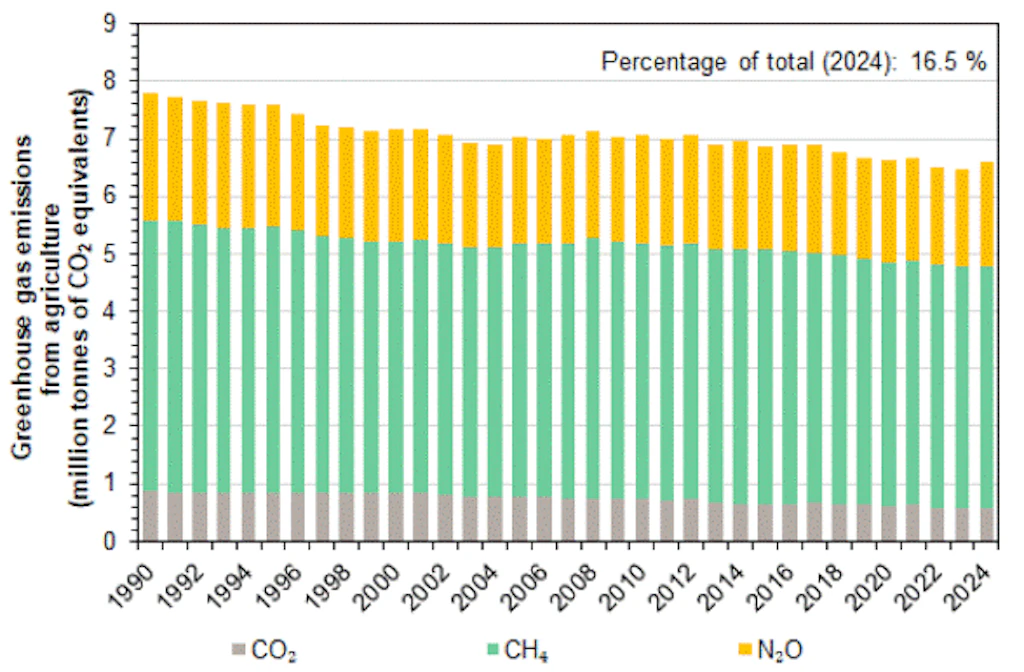
Not only is agriculture responsible for the greenhouse gas emissions shown here, but also influences the greenhouse gas balance of agricultural soil in the Land Use sector. The associated emissions and removals are shown on the following website:
The climate impact of methane
In order to compare the effects of different greenhouse gases on the climate, climate reporting uses the global warming potential (GWP100) in accordance with international agreements. GWP 100 describes how strongly a greenhouse gas influences global warming over a period of 100 years compared to carbon dioxide (CO₂). In the case of the greenhouse gas methane, the internationally used GWP100 does not fully reflect its properties: methane remains in the atmosphere for only around ten years on average, but has a very strong warming effect during this time. The GWP100 underestimates this very strong short-term climate impact of methane. On the other hand, its long-term impact is overestimated.
Unlike CO2, which remains in the atmosphere for thousands of years and accumulates steadily, the climate impact of methane can decrease rapidly if its emissions are reduced. In global scenarios to limit warming to 1.5 °C, CO₂ emissions must fall to net zero by 2050. Methane emissions, on the other hand, must be reduced by 35 to 70 percent.