

Life cycle assessment
Life cycle assessment (LCA) is a method for quantifying and evaluating the environmental impact of a product, service, process, company – or even an entire economy.
A product's life cycle assessment covers its entire existence, from raw material extraction and manufacturing through transport and use to reclamation or disposal. Along this life cycle, the consumption of energy and resources (water, raw materials, land etc.) is determined, as well as the production of waste and emissions to air, water and soil. The resulting environmental impacts are then assessed and grouped into categories such as climate change, eutrophication or acidification.
The 4 phases of life cycle assessment
A life cycle according to ISO 14’040 is structured into 4 phases which are described below.
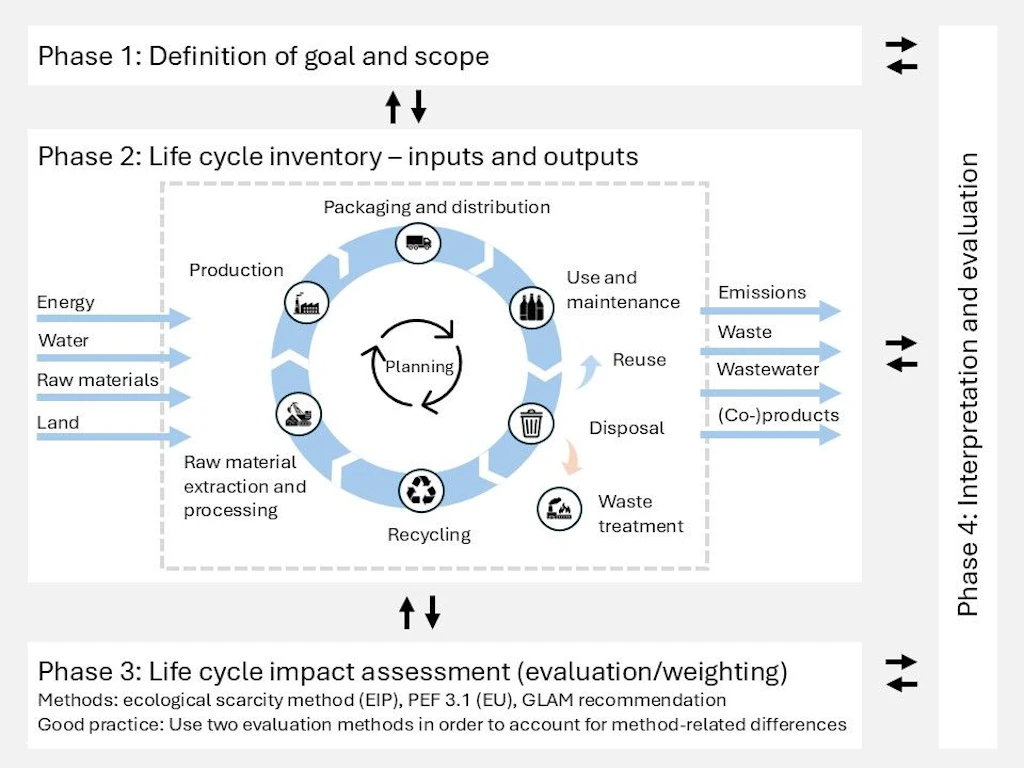
1. Definition of the goal and scope of the LCA – what questions should it answer?
Defining the goal and scope of the investigation is decisive for the quality of results. The system boundaries and starting assumptions have a particularly significant impact on the results.
If several variants are being compared, a uniform basis must be established. A functional unit is defined for this purpose: a product-specific quantity used as a reference for comparing environmental impacts. Examples include 1kg of bread, 1kWh of electrical energy or1km of travel by car.
2. Life cycle inventory: collecting data – what resources are consumed and what emissions occur?
In the life cycle inventory phase, the natural resources, material and energy requirements, as well as the emissions and waste generated, are recorded for each individual processing step within the system boundaries. The result of the life cycle inventory includes the resource requirements as well as the emissions and waste of the entire system.
If several products are produced within the system, for example wheat as the main product and straw as a by-product, the environmental impacts of production must be divided between wheat and straw – a process known as allocation. Allocation must be described transparently.
A life cycle inventory requires detailed environmental data on products and services. A distinction is made between the foreground system, which can be directly influenced by management decisions, and the background system with upstream and downstream areas.
The data for the foreground system is collected specifically for a study, while the data for the background is taken from databases. Background data includes standard processes and supply chains, such as the provision of fuel and steel. The Swiss Federal Administration offers a high-quality background database (BAFU:20XY) free of charge.
3. Life cycle impact assessment – How much is the environment affected?
The resulting life cycle inventory is then used to assess the environmental and health impacts caused by the identified pollutant emissions and use of natural resources and energy. This impact assessment assigns the detailed results of the life cycle inventory to various impact categories. Based on scientific findings, substances with similar effects are grouped into various environmental issues, for example climate change, acidification or eutrophication.
Substances that contribute to climate change are referred to as greenhouse gases and are characterised according to their global warming potential as defined by the Intergovernmental Panel on Climate Change (IPCC). The contribution of specific emissions to each impact category is determined by impact factors. For example, nitrous oxide has a 265 times stronger climate impact than CO2. The global warming potential is then expressed in kg CO2 equivalents.
Several methods are available to evaluate life cycle inventory data, each with its own strengths and weaknesses. The ecological scarcity method is commonly used in Switzerland, expressing results as eco-points known as environmental impact points (UBP). The best-known method in Europe is the (Product) Environmental Footprint (P)EF.
The FOEN recommends using at least two different impact assessment methods when carrying out life cycle assessments, which provides a sensitivity analysis allowing the identification of method-related distortions.
4. Evaluation and interpretation - what do the results mean?
In the fourth phase - the evaluation - the results of the life cycle assessment and the underlying models and data are critically examined, and the robustness of the results is verified through sensitivity analyses. The results are then interpreted in light of the initial questions and, if necessary, the decisions to be made. Recommendations can be made or ecological performances attested (e.g. reduction in greenhouse gas emissions).
Life cycle assessment contributes to system-wide thinking in business, administration and the community. It complements specific approaches to environmental protection such as air pollution control, water protection and soil conservation.
Life cycle assessments in the private sector support the identification of opportunities and risks in the value chains, which are increasingly important for business success. The thorough analysis of a product from development to disposal, inherent to life cycle assessment, enables targeted ecological and energy-related optimisations that bring the greatest environmental benefit or have the most favourable rate of ecological benefit per economic expenditure. Furthermore, life cycle assessment is appropriate for improving the environmental information on products.
The life cycle inventory database BAFU:20XY
The Swiss Federal Administration uses life cycle assessments in analysis, implementation of legislation and green public procurement. These applications require well-documented, reproducible, quality-controlled and transparent life cycle inventories (LCIs). To meet these needs, the FOEN compiles and updates LCIs in collaboration with other public and private entities, and ensures their public availability in a transparent and consistent database.
The Federal Administration's database “BAFU:20XY” (XY is the year of publication) contains data on energy, transport, building materials, chemicals, paper and pulp, waste treatment and agriculture, and is based on data quality guidelines. It comprises LCIs covering inland production as well as the manufacturing of main import products.
In accordance with Switzerland's Open Government Data Strategy and the Federal Council's 2024–2027 Action Plan for the Sustainable Development Strategy (SNE 2030), the LCIs funded by the Federal Administration are made available free of charge. The Federal Administration ensures regular updates of the background data, enabling reliable LCA-based support of decision-making. The specific methods of data collection and LCA calculation are extensively recorded in thematic reports, available below under “Further information”.
Current downloadable version of the Federal Administration’s LCA database (BAFU:20XY):
openLCA Nexus - Your source for LCA and sustainability data. BAFU:20XY
The ZIP file containing the database also includes all the associated reports, as well as an Excel file with the key indicators for each data set.
Under ‘Further information’, links to life cycle assessment calculators are listed, including the ‘Corporate Footprint Calculator’, the ‘KBOB/ecobau life cycle assessment data’ for the construction sector, and the transport environmental calculator. Like many other life cycle assessment applications, these are based on the BAFU:20XY database.
Frequently asked questions concerning the LCA database BAFU:20XY
Suggestions for improvement of the database or single datasets as well as questions concerning the BAFU:20XY life cycle inventory database are welcome and may be addressed to lca@bafu.admin.ch
The ecological scarcity method (UBP method)
The ecological scarcity method (UBP method, UBP-Methode in German) is a Swiss-developed procedure to assess environmental impacts in LCA. It accounts for a broad spectrum of environmental impacts and aggregates them into a key figure expressed as environmental impact points (UBP).
The method's core variables, known as eco-factors, indicate the environmental impact of pollutant emissions, resource extraction and waste generation. The eco-factors are derived from environmental targets and threshold values set by Swiss legislation or international agreements. The eco-factors for greenhouse gas emissions, for example, are based on the targets set by the Intergovernmental Panel on Climate Change (IPCC) and Switzerland's climate targets.
The more current emissions or resource use exceed the defined environmental protection target, the higher the eco-factor. This approach is also known as the distance-to-target principle. The amounts of individual environmental impacts are multiplied by the corresponding eco-factors. The resulting environmental impact points (UBP) obtained for each individual environmental impact are then added together, producing a total score. This score expresses the total level of environmental impact of the object of study.
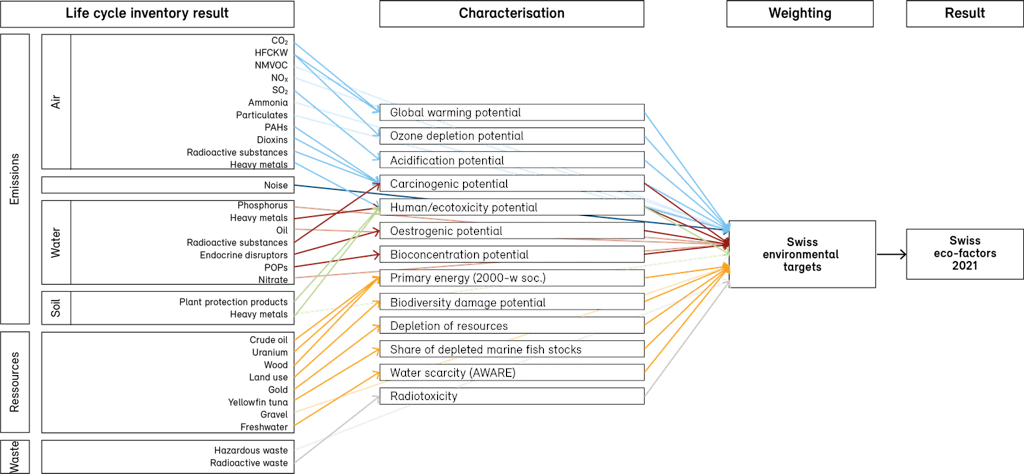
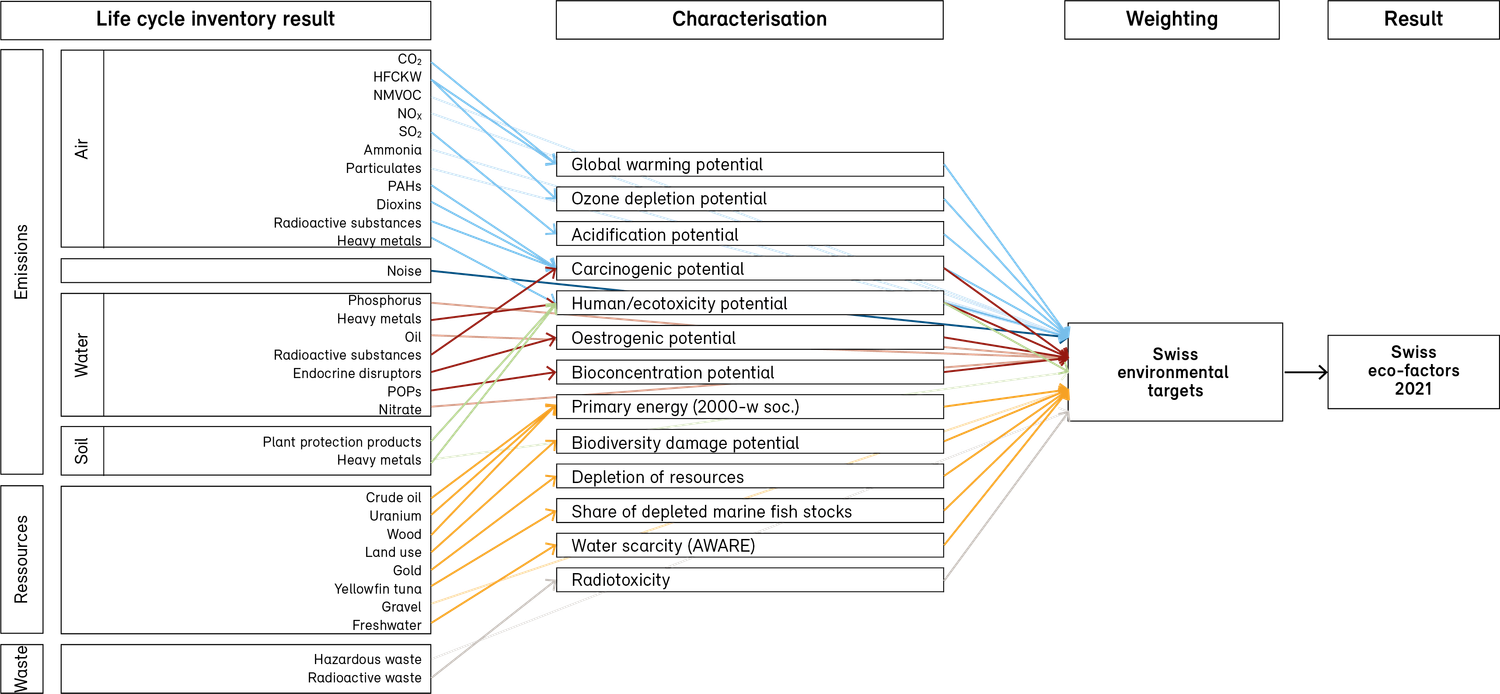
A major strength of the UBP method is that of all available assessment methods, it considers the broadest range of relevant environmental impacts while excluding duplicate quantification. It therefore provides a reliable overall picture of environmental impacts. The UBP method is updated and extended approximately every seven to ten years. The current status of the method is described in the report “Swiss Eco-Factors 2021 According to the Ecological Scarcity Method” (UBP method 2021).
The UBP method with Swiss eco-factors is a reference method for life cycle assessments relating to Switzerland. However, it can also be used in other countries, since eco-factors can be adapted to reflect regional conditions. For example, water scarcity in agricultural production in southern Spain can be taken into account by using a regionally adjusted eco-factor for water consumption.