

Macroeconomic impacts
Climate change is having an impact on our economy. It causes damage that leads to reduced value added, job losses and lower tax revenues. Targeted adaptation measures can mitigate these negative effects whilst simultaneously triggering various other economic benefits, such as additional value added and employment in other sectors.
The study analyses the macroeconomic impacts of the following five climate risks in Switzerland in 2060, with and without (global) climate protection, and with and without adaptation:
- Performance losses at work due to increased heat stress
- Yield losses in agriculture due to increasing drought
- Loss of revenue in winter tourism due to a rising snow line
- Property damage and personal injury caused by heavy rainfall
- Property damage caused by storms and hailstorms
For other climate risks, no cost estimates are available, or the damage or adaptation costs cannot be modelled due to a lack of data and baseline information.
The project represents an important step towards gaining a better understanding of the diverse impacts and costs of climate risks on the Swiss economy, as well as the financial implications for the state, the private sector and households.

Findings and results
Climate change causes significant economic damage. Adaptation measures not only help to protect human health and the environment, but also make economic sense. The challenge lies in taking early action to minimise long-term burdens on the economy and society.
Economic impacts of selected climate risks
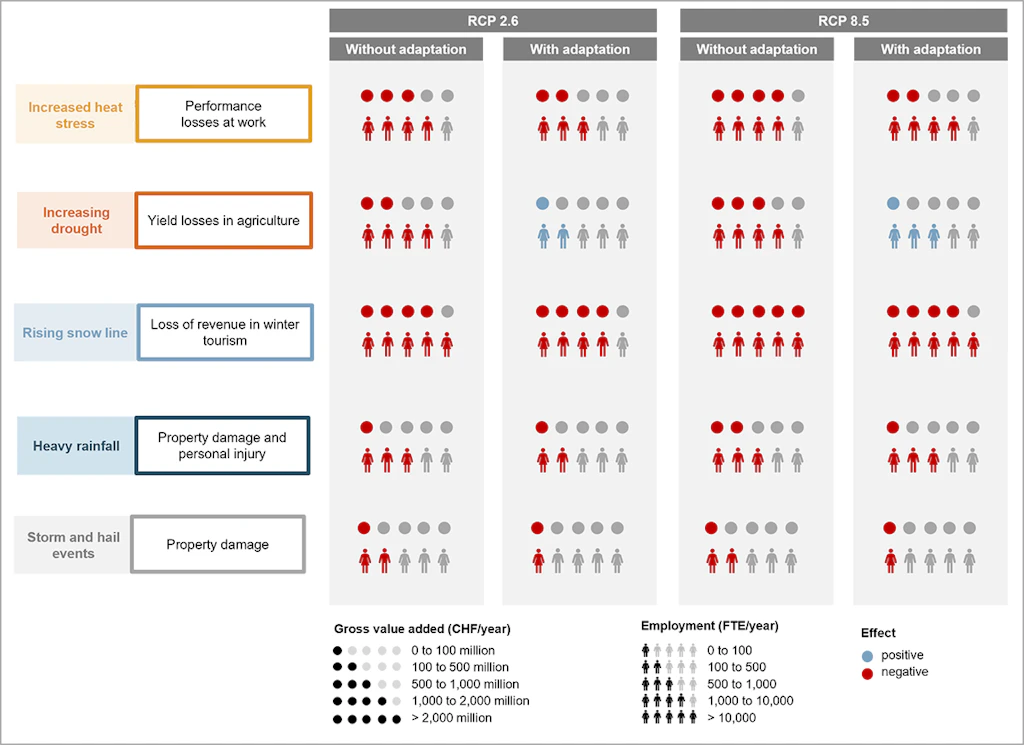
- The modelled economic impacts in 2060 vary greatly depending on the climate risk and may even be slightly positive in some sectors thanks to targeted adaptation measures.
- According to the modelling, the greatest economic losses will occur in winter tourism. Significant losses are also expected in agriculture and due to performance losses at work.
- With adaptation, losses can be reduced across all climate risks. In agriculture, from a macroeconomic perspective, these losses can even be turned into gains, as yield losses are largely prevented, whilst investments in irrigation systems generate positive economic impetus.
Note
The modelled results show only part of the macroeconomic impacts of climate change in Switzerland. Furthermore, only selected risks and aspects were modelled, and various simplifications were made and assumptions taken. The climate risks are also considered in isolation, and existing interactions between the climate risks and adaptation measures are not taken into account. The results should therefore not be understood as exact figures, but rather as indicative orders of magnitude. The actual losses may be significantly higher in individual years.
Detailed analysis results for the selected climate risks
What impacts and costs will climate change cause in Switzerland by 2060? How can we adapt, and how much will this cost? What economic impacts will climate change and adaptation have on Switzerland by 2060?
The results report describes the climate risks analysed and highlights the key findings, assumptions and uncertainties: