

Risk identification and assessment
In general, risk is defined as the possibility that a specific event will cause harm. Risks can be identified and assessed using systematic and scientific methods, and thus serve to measure safety and prioritize protective measures.
What does “risk” mean in the context of natural hazards?
Risk is the probability that a hazardous event (e.g., flooding) will occur and result in damage. The extent of the damage depends on the following factors:
- the number of people and assets that are potentially exposed to the hazard,
- the level of exposure of people and property,
- the vulnerability of the individuals and goods affected.
The assets at risk can be of many different kinds, such as people, animals, buildings, infrastructure, facilities of significant economic importance or impact, natural resources, or cultural assets. In addition to economic factors, they may also have ecological and social implications. The loss of these assets often results in serious consequential damage.
Risk = Probability × Potential Loss (Extent of Loss), where:
- Probability = the likelihood of the event occurring
- Potential damage = potentially affected people and assets × exposures × vulnerability
How is the risk expressed?
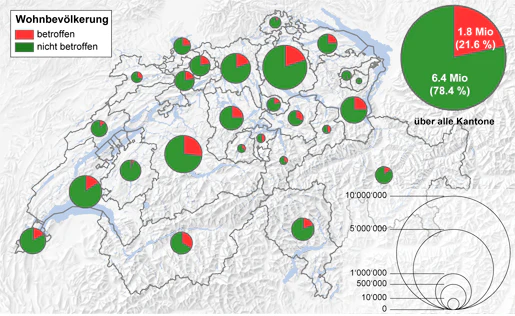
Risks associated with natural hazards are often expressed as annual expected loss figures, measured in terms of “number of fatalities per year” or “francs per year.” However, risk can also be described in other ways, such as the number of people or assets potentially affected (see chart “Resident population affected by natural hazards”).
How are risks identified and assessed?
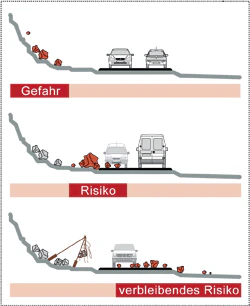
Risks are identified through risk analyses based on systematic and scientifically sound methods. Risk analysis is used to characterize and quantify risks as objectively as possible.
In contrast, risk assessment is used to determine which risks are considered acceptable and which are unacceptable. A risk is considered acceptable if it is judged to be tolerable for valid reasons. Risk assessments answer the question: “What is permissible?” In this way, risk assessment helps identify any need for action and establish priorities. In principle, society as a whole decides what level of residual risk should be accepted.
In addition, risk acceptance also depends on the behavior and responsibility of the individual.
How high is the risk exposure in Switzerland?
Nationwide analyses show that about one-fifth of Switzerland’s built-up areas are exposed to natural hazards, particularly flooding. Approximately 1.8 million people live in these areas and are potentially at risk of flooding.
In Switzerland, the concentration of valuable assets in areas at risk is steadily increasing. This also leads to an increase in potential damage from natural hazards and, consequently, in risks (an increase in the number of at-risk properties, the value of the assets at risk, and their vulnerability to damage). Consequently, these risks could be managed primarily through land use and spatial planning. A thorough understanding of the risks is essential for effective measures, yet a risk overview at the national level is still largely lacking. For this reason, the development of risk analyses will take on great importance in the coming years.