

Road traffic noise
Road traffic noise affects a large number of people in Switzerland, especially in cities and conurbations. Despite improvements in protective measures, road noise remains a challenge to health and quality of life and generates external costs of around CHF 2 billion a year.

Around 740'000 people in Switzerland are affected by road traffic noise exceeding the limit values, particularly in urban areas. This constant exposure leads to stress, which can cause serious illness, and generates considerable costs. If noise limit values are exceeded, the federal government, cantons or communes are obliged to take action and improve their roads.
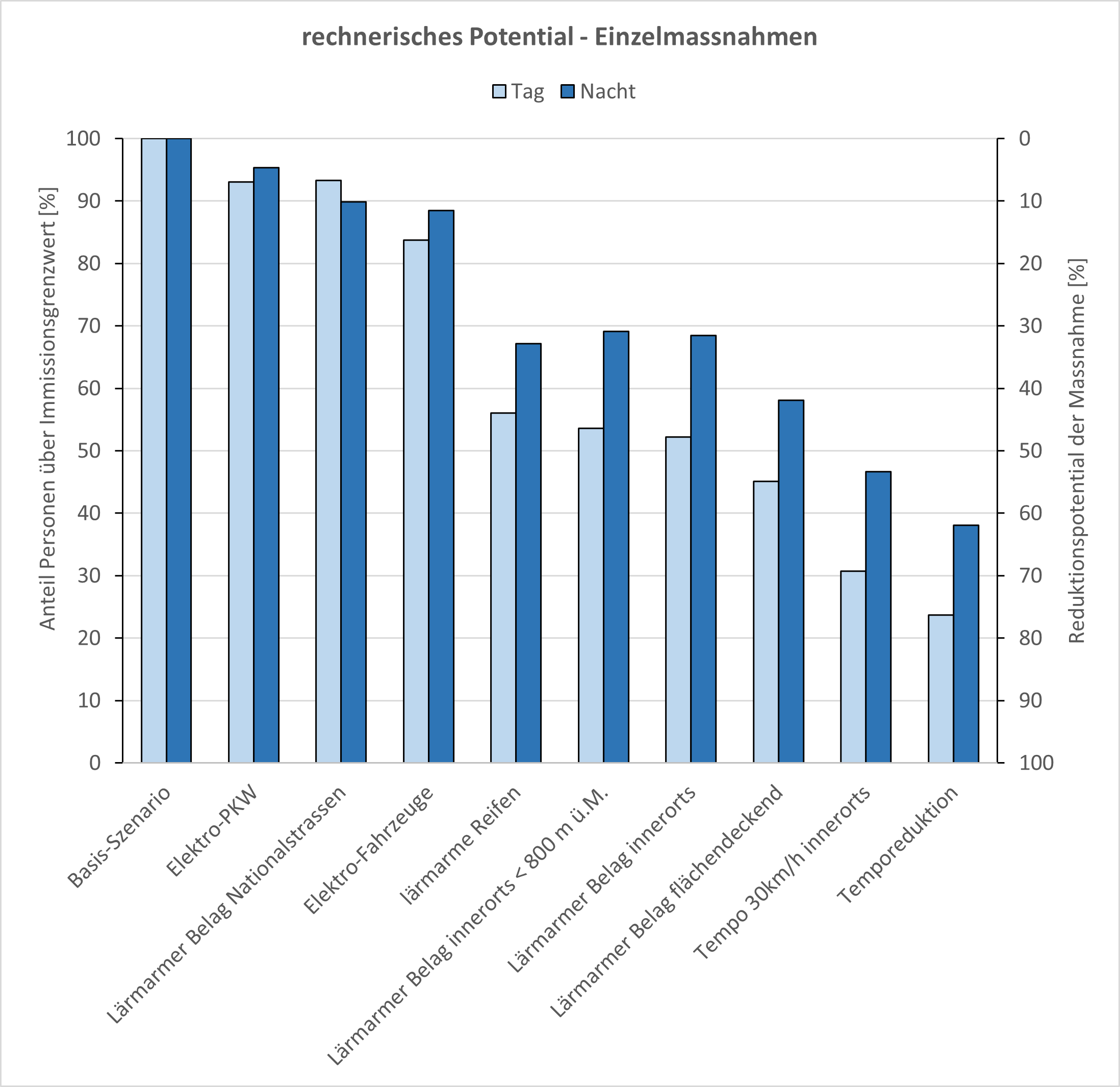
The Environmental Protection Act (EPA) and the Noise Abatement Ordinance (NAO) prioritise measures to counteract noise at its source. This approach ensures that noise is reduced right at the point of origin. Priority is therefore given to measures such as low-noise road surfaces and speed restrictions. Lower speeds reduce rolling noise, and the cavities in low-noise surfaces absorb part of the sound. This is important, because rolling noise from cars starts to exceed engine noise at just 25 km/h.
Since 1985, more than CHF 5 billion has been invested in road improvements, protecting over 380,000 people from road noise exceeding the limit values. For main roads and other roads, around 900'000 people had benefited from noise protection measures by 2023. However, a large number of people are still affected by road traffic noise exceeding the limit values. Noise reduction is an ongoing task. The federal government provides the cantons with financial support.
Measures against road traffic noise
Further information
Low-noise road surfaces
Rolling noise from cars starts to exceed engine noise at just 25km/h. Low-noise road surfaces can reduce noise significantly. Unlike soundproof walls or windows, this restricts the amount of noise that is actually generated. The Federal Office for the Environment (FOEN) is involved in research into low-noise road surfaces and provides funding for them to be laid on urban roads.
Speed reductions
Reducing speed lessens road noise right where it is generated. If, for example, the speed limit is reduced from 50 to 30km/h, this has the same effect on noise as if the traffic volume were halved.
Quiet tyres
Noise emitted by tyres starts to exceed engine noise at just 25 km/h. The trend towards ever heavier vehicles with wide tyres is increasing rolling noise. However, quieter tyres can reduce noise directly where it is generated.
Loud vehicles
Individual vehicles cause disruptive noise peaks that stand out from usual road noise. This disturbance can usually be avoided if drivers change their driving style and do not modify their vehicles in ways that increase noise.