

Published on 13 July 2026
Spatial planning measures
Open spaces for recreation and good acoustic conditions are essential elements of sustainable inward urban development—especially in noise-affected areas. Well-designed open spaces are important for well-being and health, enhancing housing quality and urban living conditions. Article 24 of the Swiss Environmental Protection Act (EPA) specifies that, when planning residential areas in noise-affected locations, both recreational open spaces and measures to improve residential acoustic quality must be provided.

Open spaces contribute to recreation and promote public health. Even with increasing land-use intensity and consolidation, open spaces can significantly enhance the quality of life and living conditions. Whether as urban parks, green areas, or squares, open spaces offer diverse opportunities for daily recreation and restoration: people can walk, move freely, meet others, or enjoy being alone without disturbance.
Moreover, open spaces have positive effects in relation to noise. For example, green areas near residential buildings reduce the annoyance caused by road and rail traffic noise. Merely the view of greenery can reduce subjective noise annoyance—without actually reducing sound levels. The more green space available, the better its accessibility and reachability, and the more people enjoy spending time there, the more positively the surrounding environment is perceived.
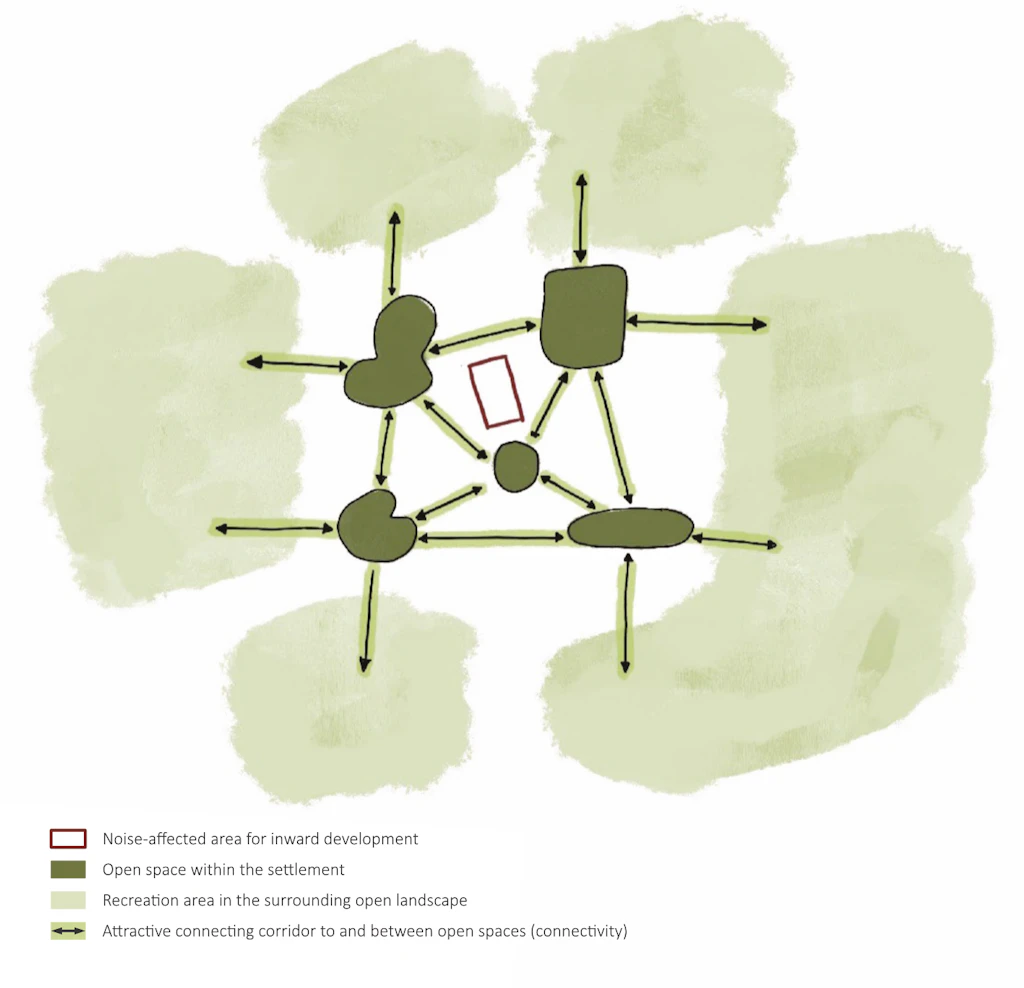
A diverse range of open spaces and their good accessibility can significantly improve residential acoustic quality in densified areas. Source: Krass et al., 2025. Kompendium Bauzonen in lärmbelasteten Gebieten. Rapperswil: OST. In addition to open spaces, measures to reduce noise at the source are crucial. These primarily include noise-reducing measures for road traffic infrastructure and optimised traffic management. Even if these measures do not comply with the limit values, they should be implemented whenever feasible, as they contribute to good urban living conditions.

Low-noise road surfaces, multifunctional street spaces, and the promotion of slow traffic can improve the quality of life in areas for inward development. Source: Krass et al., 2025. Kompendium Bauzonen in lärmbelasteten Gebieten. Rapperswil: OST. Buildings and surfaces also play a role in acoustic quality, as they reflect sound. For example, the design of a facade (material choice, structure) and its orientation determine its acoustic effect (e.g., reflective vs diffusely scattering). Such an effect can influence whether people perceive a specific outdoor space as quieter than others. This is particularly relevant for large buildings, as they can amplify noise when interacting with other large buildings and surfaces.
Architecture, outdoor and environmental design, and street design can positively influence sound propagation and noise perception, thereby audibly improving the quality of residential areas.
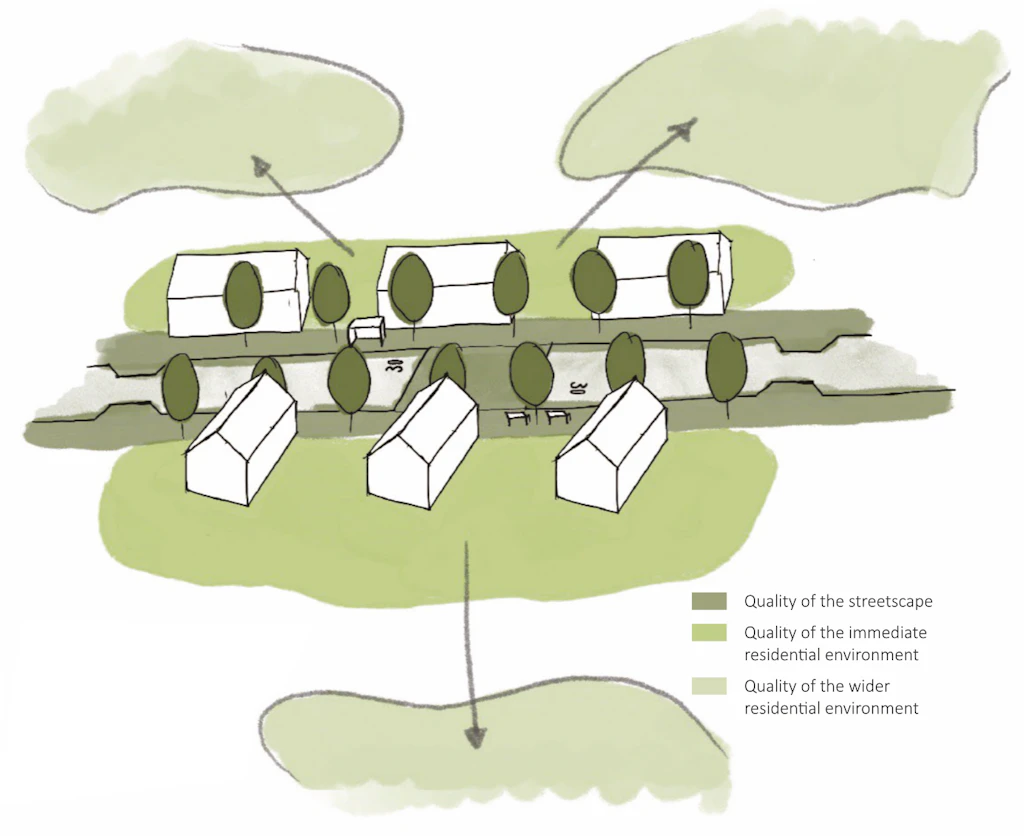
Measures in street spaces, architecture, and open space design can change local acoustic conditions and influence how people perceive and use these spaces. Source: Krass et al., 2025. Kompendium Bauzonen in lärmbelasteten Gebieten. Rapperswil: OST.
Construction and Planning in Noise-Affected Areas
The regulations regarding construction and planning in noise-affected areas have been amended, effective from 1 April 2026. The changes to Articles 22 and 24 of the Environmental Protection Act (EPA), along with the clarifications provided in the Noise Abatement Ordinance (NAO), aim to encourage inward urban development while ensuring improved coordination with environmental noise management.
New residential zones (zoning) and changes to existing zones (rezoning) may be designated if they meet the appropriate noise limit values or if measures are taken to bring noise levels below these thresholds.
If compliance with noise limit values is not feasible with reasonable effort, municipalities can, under certain conditions, still designate new building zones or adjust existing ones. When planning residential areas, open spaces and residential quality must be taken into account.
The compendium Building Zones in Noise-Affected Areas by the OST University of Applied Sciences demonstrates how, in accordance with Article 24 of the EPA and Article 29 of the NAO, inward development can be implemented to a high standard through careful open-space planning and acoustic measures, even in noisy locations.
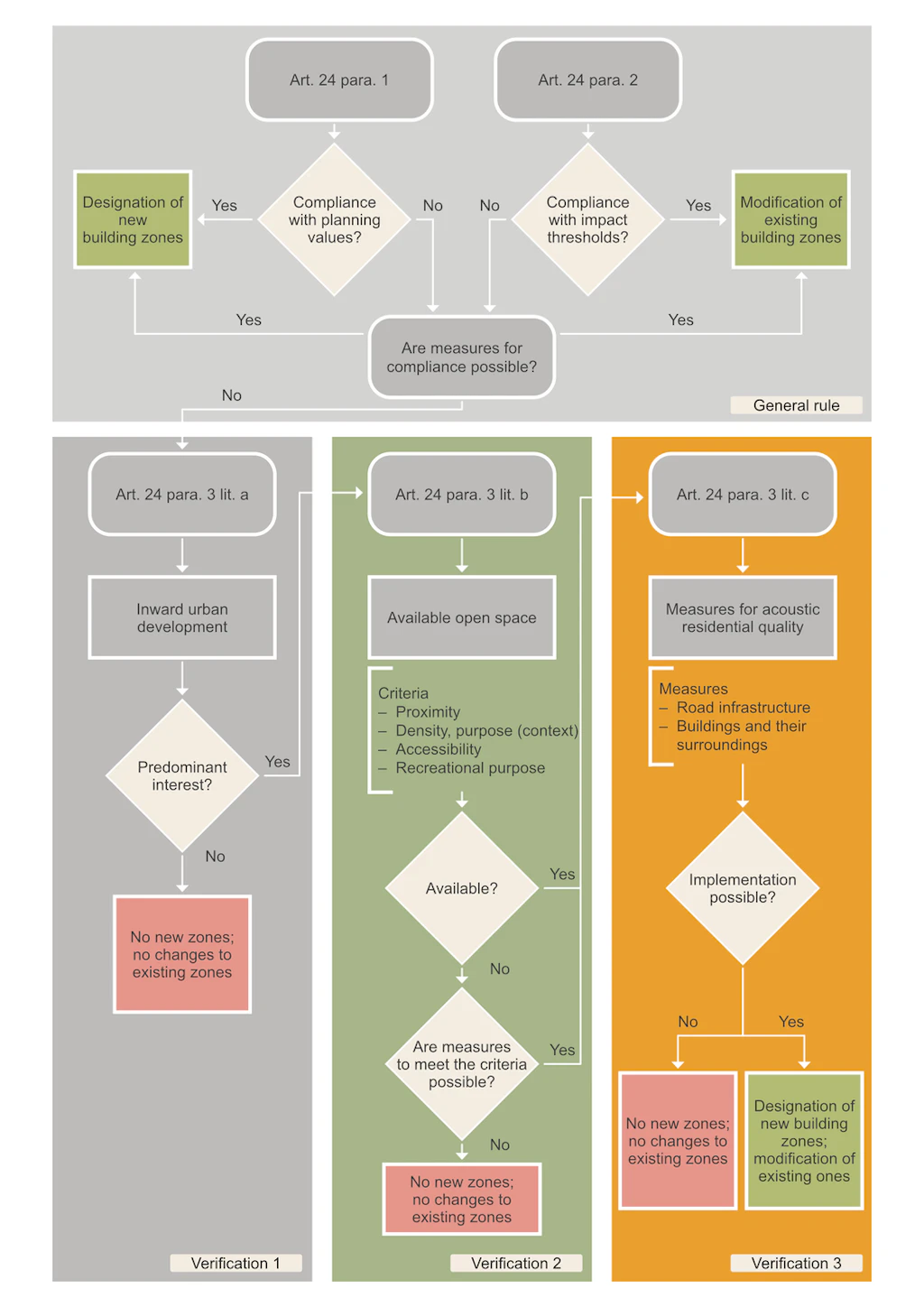
Systematics of Article 24 EPA for building zones in noise-affected areas. Source: Explanations on the revision of the Noise Abatement Ordinance (NAO). The new regulation allows municipalities to issue a building permit for a residential building if noise limit values cannot be met with reasonable effort. In such cases, provided that each residential unit is equipped with a ventilation system and a cooling system, among other conditions, the permit may still be granted.
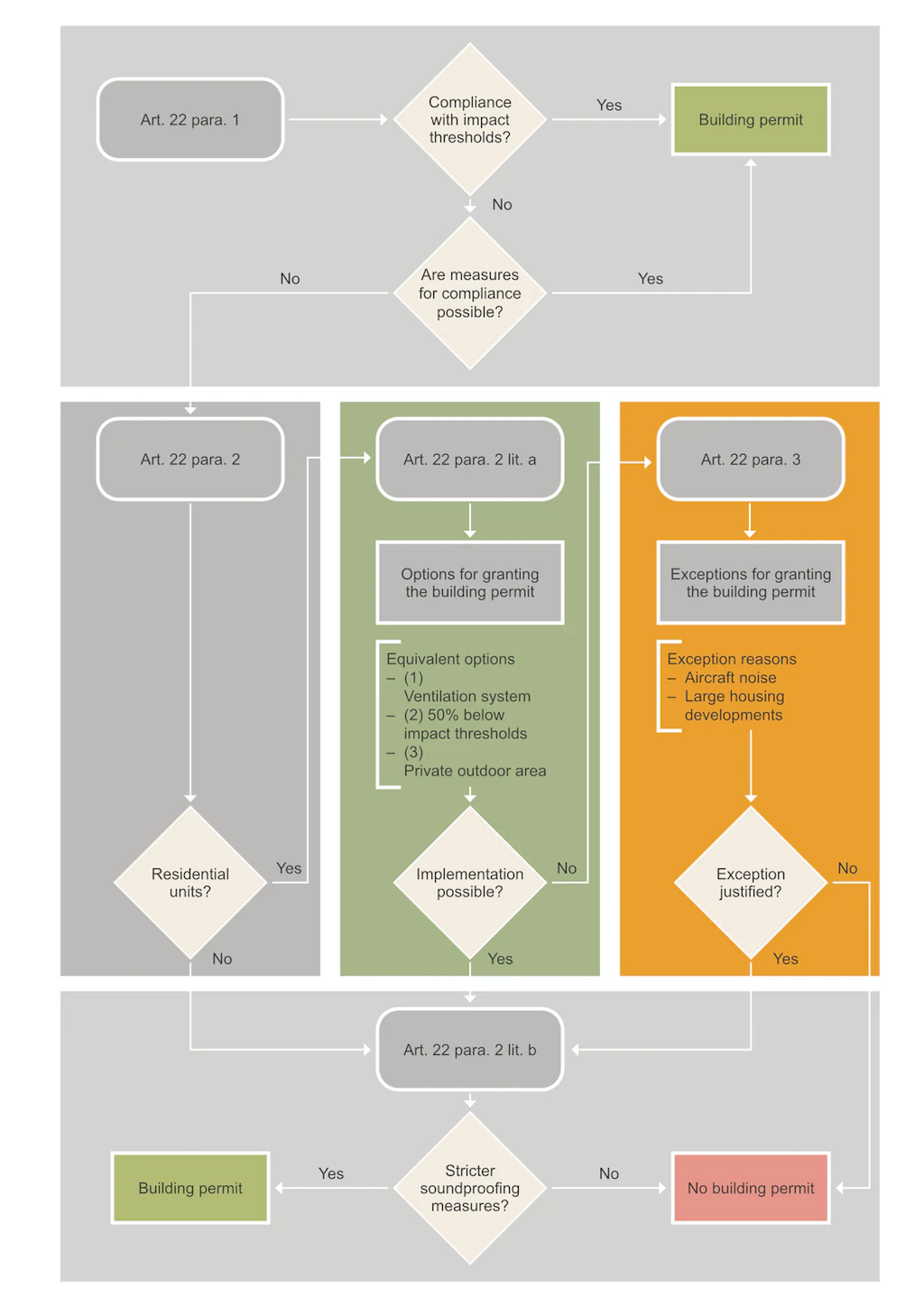
Systematics of Article 22 EPA for building permits in noise-affected areas. Source: FOEN, 2026.
Further information
Acoustic quality in outdoor spaces
Evaluation of measures
Case studies
City acoustics seminar