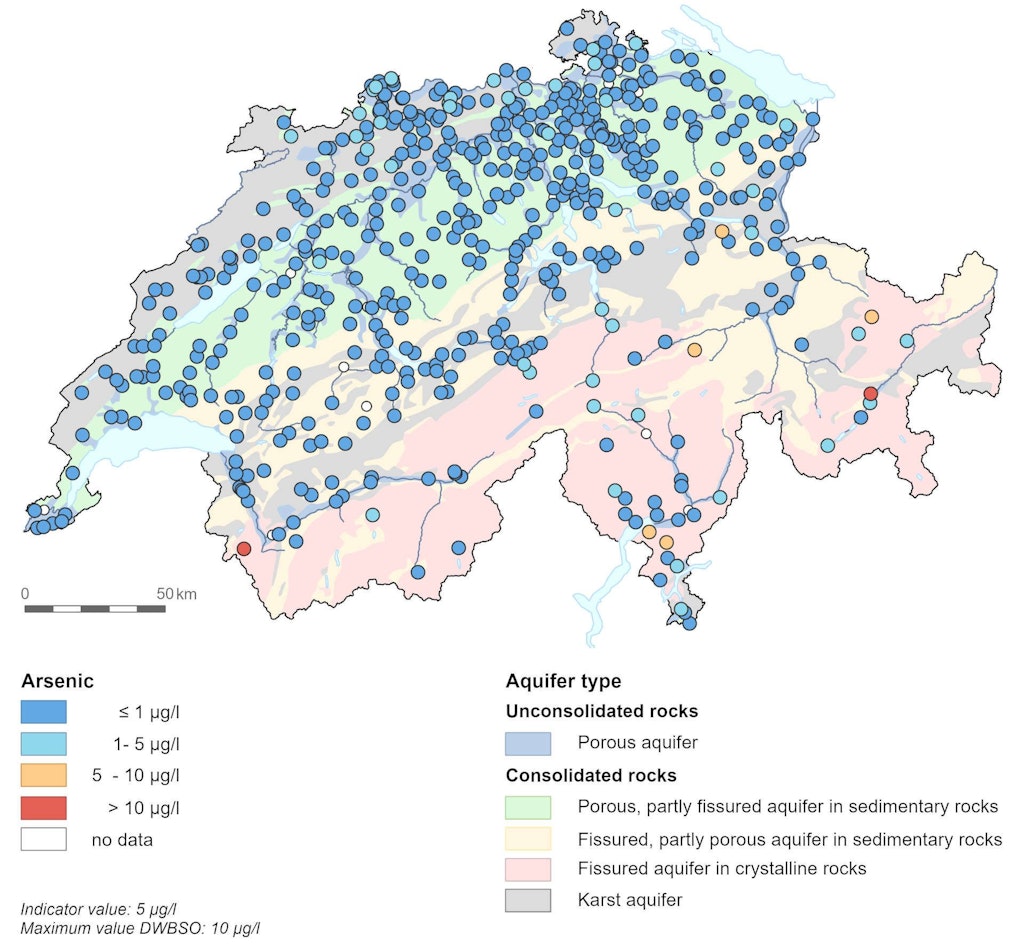
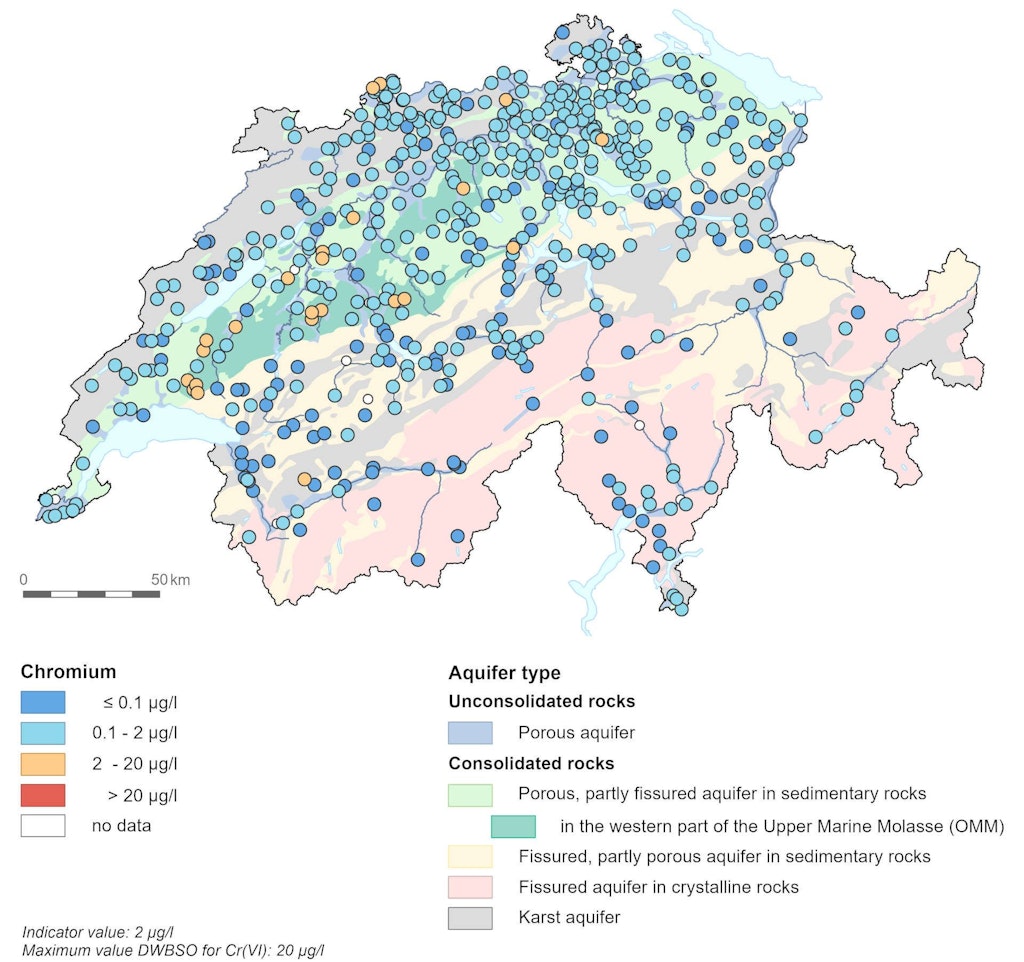
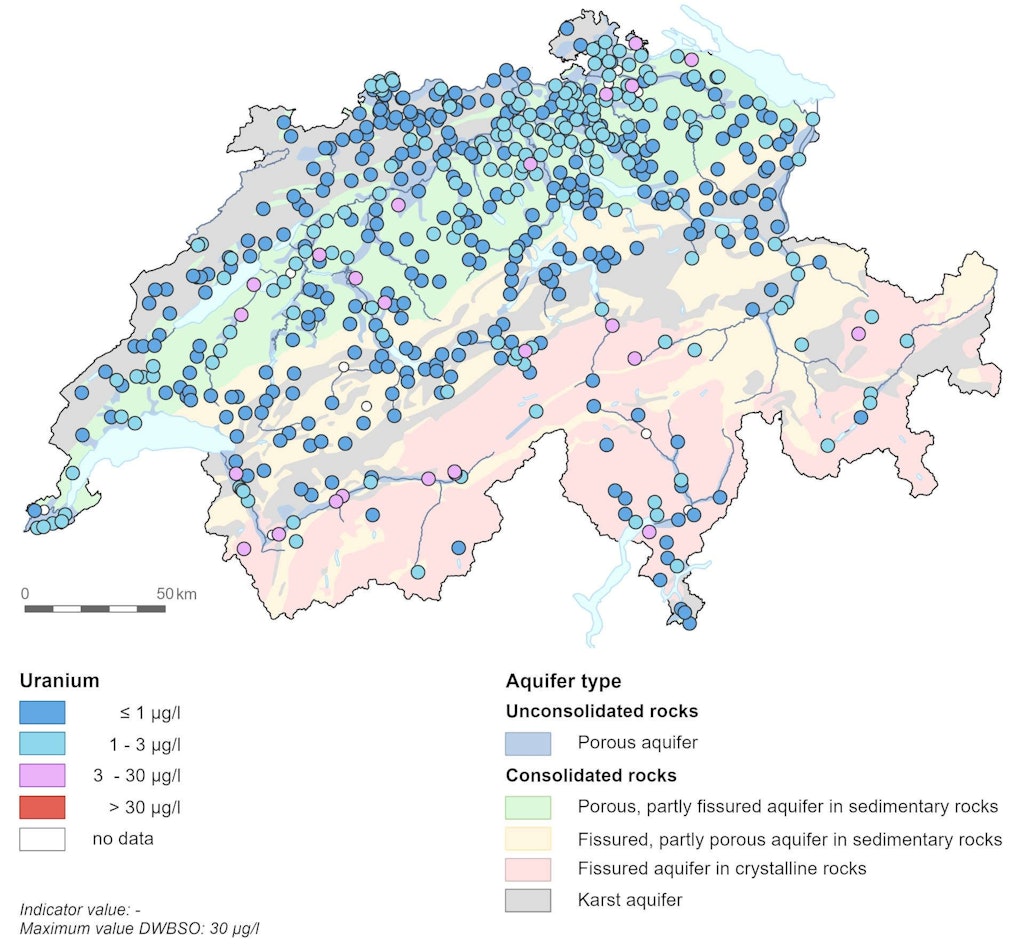
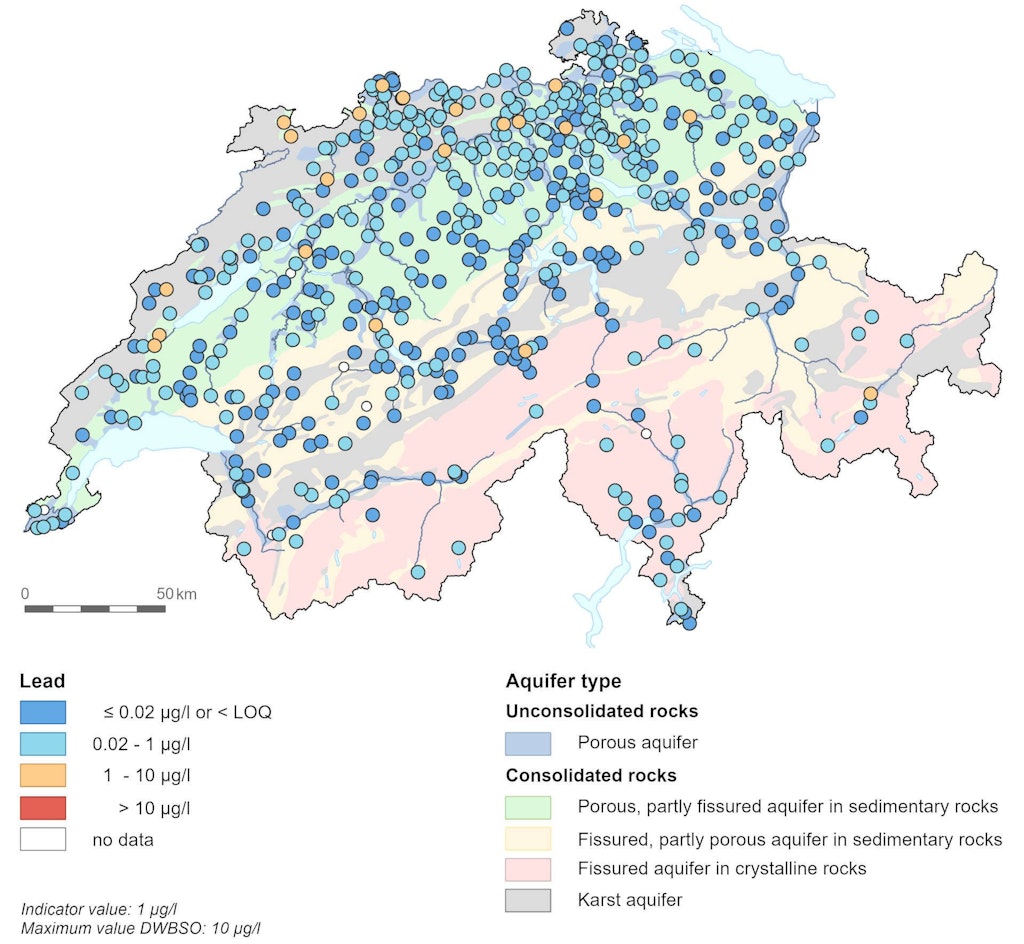
The concentrations of trace elements in groundwater are usually low and primarily reflect natural background values. Groundwater resources in crystalline rocks have the highest concentrations of arsenic and uranium. Slightly elevated concentrations of lead, boron, bromine, cadmium, copper and zinc occur mainly in porous aquifers in unconsolidated rocks under settlements and agricultural areas.
Trace elements are chemical elements that occur naturally in very low concentrations in the Earth's crust. They mainly enter groundwater through the weathering of rocks. Trace elements generally occur in groundwater in concentrations of nanograms per litre (ng/l) or micrograms per litre (µg/l).
The Waters Protection Ordinance (WPO) does not set out limit values for trace elements in groundwater. The WPO does stipulate that groundwater used or intended for use as drinking water must comply with the requirements for drinking water under the food legislation – by means of basic treatment, if necessary. In effect this means that the maximum limits of the FDHA Ordinance on Drinking Water and Water in Public Baths and Shower Facilities (DWBSO) also apply to groundwater, unless the WPO contains separate limits. The DWBSO specifies maximum values for trace elements such as antimony, arsenic, boron, cadmium, chromium, copper, lead, nickel, selenium, uranium and zinc. The maximum allowable concentrations of aluminium, iron and manganese are also specified in the DWBSO. Water treatment uses flocculants made from aluminium and iron salts during filtration, which can raise iron and manganese levels. Increased concentrations of iron and manganese can negatively impact drinking water reservoirs, as they can cause technical problems in the installations and pipes and affect the taste of drinking water.
The Groundwater Protection Guideline additionally provides values for individual trace elements that may indicate problematic anthropogenic pollution of groundwater. Increased values due to natural (geogenic) conditions are excluded. For heavy metals, these indicator values are identical to the limit values specified in the WPO for the dissolved fraction in surface waters.
All 550 sites of the NAQUA National Groundwater Monitoring were sampled and analysed for more than 20 trace elements as part of a pilot study conducted in 2018. The concentrations refer to unfiltered samples, i.e., they indicate the total concentration of the elements in the groundwater, regardless of whether the substances were present in the samples in dissolved or undissolved from (bound to particles).
The samples rarely exceeded the limits for drinking water specified by the DWBSO – iron concentrations were too high at twelve monitoring sites (2%), aluminium at five sites (1%), manganese and arsenic at two sites each, and nickel and selenium at one site each.
Zinc concentrations were above the indicator value of the Groundwater Protection Guideline at just under 30% of the NAQUA monitoring sites, and copper at just under 20% of the monitoring sites. For Cadmium the concentrations exceed the respective indicator value at more than 5% of the monitoring sites, for lead, bromine and chromium at more than 4%, for boron at 3% and for arsenic and nickel at 1% of the monitoring sites.
While elevated concentrations of aluminium, arsenic, iron, chromium, manganese, selenium and nickel in groundwater are predominantly of natural (geogenic) origin, elevated concentrations of lead, boron, bromine, cadmium, copper and zinc are of both natural and human (anthropogenic) origin. The natural background value for these trace elements could not be determined with the available data set, as the anthropogenic content at most monitoring sites in unconsolidated aquifers on the Central Plateau was already so high that the available statistical methods could not separate it from the natural background value (reference to study by the University of Bern).
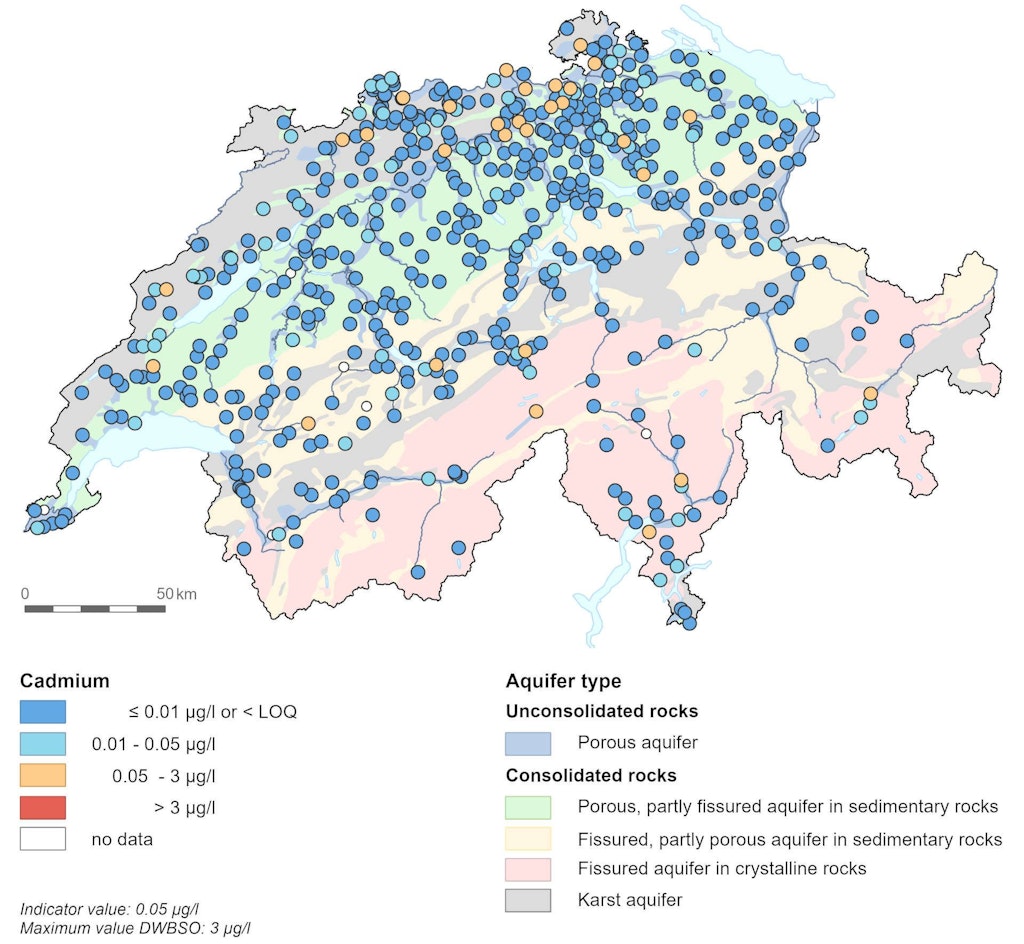
Concentrations of boron are slightly elevated in groundwater resources below settlement areas and those of cadmium are slightly elevated below arable land. The concentrations of lead, bromine, copper and zinc in groundwater are slightly elevated under both settlements and agricultural areas.
Anthropogenic sources include fertilisers (boron, cadmium, copper, zinc) and pesticides (copper) in agriculture, emissions from industry and waste incineration (bromine, cadmium), run-off from roofs, facades and along roads (lead, copper, zinc), and domestic wastewater (boron).
In addition, the results for zinc, iron, copper or lead may have been distorted by galvanised installations of iron or steel or pipes containing copper or lead at the monitoring sites.
Arsenic concentrations are generally low. In the Swiss Plateau and the Pre-Alps, concentrations are mostly below 1µg/l. Locally elevated concentrations above 5µg/l occur almost exclusively in crystalline fissured aquifers in the Alps and on the southern side of the Alps. These are attributed to natural ore deposits and crystalline rocks with elevated arsenic content.
The DWBSO maximum value for arsenic in drinking water of 10µg/l was exceeded at one monitoring site each in the cantons of Valais and Graubünden. The elevated concentrations are attributed to geogenic sources in crystalline rocks.
The chromium concentrations are generally low at values below 2µg/l. The DWBSO specifies a maximum value of 50µg/l for chromium and 20µg/l for chromium(VI) in drinking water; these were not exceeded at any of the monitoring sites.
Concentrations above the indicator value of 2µg/l are mainly found in the western Central Plateau between Lausanne and Bern. These are due to natural chromium deposits in the molasse sandstone of western Switzerland. Isolated exceedances of the indicator values in the regions of Basel and Zurich are probably due to anthropogenic factors such as contaminated landfill sites or leaky sewage systems.
Chromium is practically only soluble in groundwater in its oxidised, hexavalent state. With the exception of isolated elevated concentrations due to chromium that is bound to particles, arising for instance in karst aquifers, it can therefore be assumed that the chromium concentrations detected are predominantly chromium(VI).
The uranium concentrations are generally low at values below 3µg/l. The DWBSO maximum value of 30µg/l for drinking water is not exceeded at any of the monitoring sites. Concentrations tend to be higher on the Central Plateau than in the Jura or the Pre-Alps. The data does not give a clear indication of whether this is due to the use of phosphate fertilisers containing uranium or due to the dissolution of naturally occurring uranium in the soil as a result of more intensive cultivation of agricultural land.
Elevated concentrations of uranium are naturally present in fissured crystalline aquifers and porous aquifers in unconsolidated rocks in the upper Rhone Valley.
The lead concentrations are generally low at values below 1µg/l. The DWBSO maximum value of 10µg/l for drinking water was not exceeded at any of the monitoring sites. Concentrations above the indicator value of 1µg/l occur mainly at monitoring sites in karst aquifers in the Jura and in unconsolidated aquifers on the Central Plateau.
Naturally occurring lead is mainly found in sulphide, sulphate and carbonate compounds. Lead can also accumulate in organic matter, iron and manganese hydroxides and clay minerals.
Anthropogenic sources of lead in groundwater include roofs, facades, roads (abrasion from roads, emissions stored in the soil from leaded petrol used until 2000, older anti-rust coatings) and lead-containing ammunition at shooting ranges.
Brass fittings at individual monitoring sites may have caused distorted readings as brass is an alloy of copper, zinc and small amounts of lead.
Cadmium concentrations are below the limit of quantification of 0.01µg/l at 80% of monitoring sites. The DWBSO maximum value of 3µg/l for drinking water was not exceeded at any of the monitoring sites. Monitoring sites with concentrations above the Groundwater Protection Guideline indicator value are mainly located in the eastern part of the Jura and on the Central Plateau. Isolated cases of elevated concentrations occur at monitoring sites in the Pre-Alps, in the Alps and on the southern side of the Alps. Over 35% of the monitoring sites with concentrations above the Groundwater Protection Guideline indicator value are located in a catchment area that is predominantly used for arable farming.
Cadmium is present in most rocks, but only in very low concentrations. It occurs in oolitic limestones in the Jura and in individual minerals, most commonly in sulphur compounds.
The main anthropogenic sources are the burning of fossil fuels or waste and the use of cadmium-containing phosphate fertilisers.
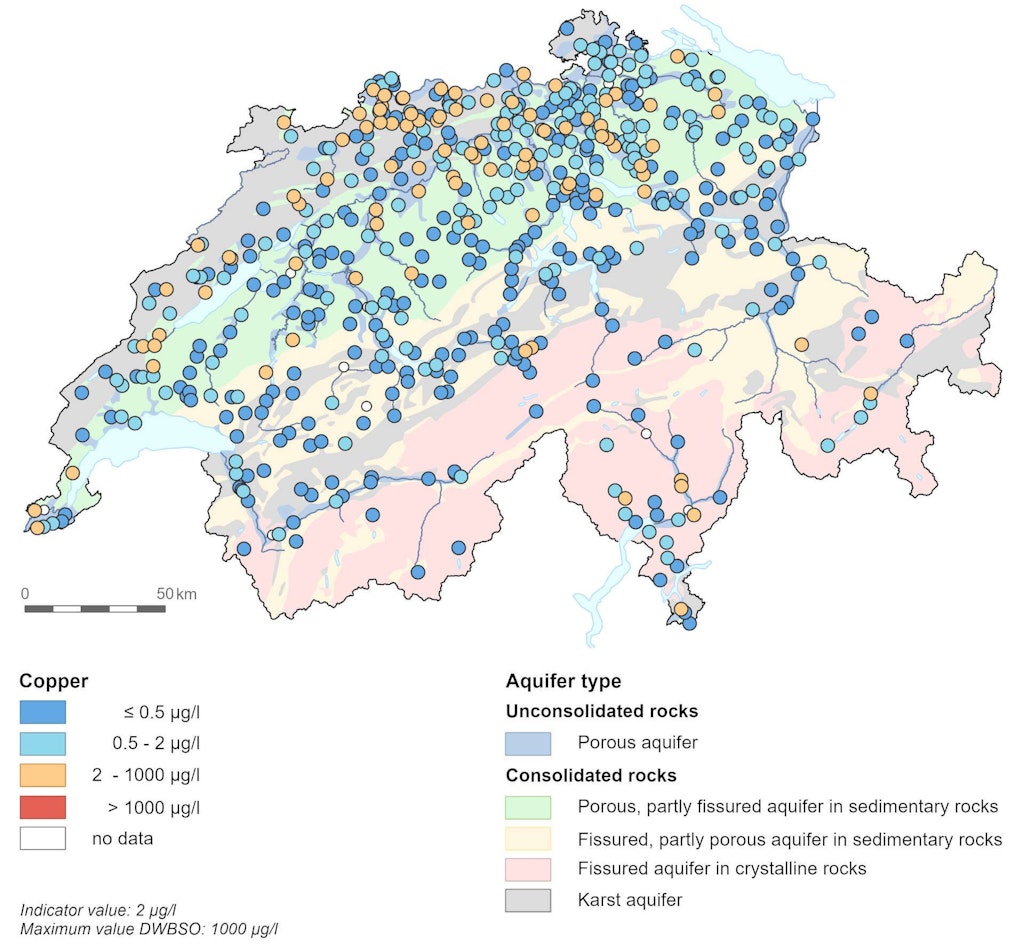
Copper concentrations in Switzerland are higher in the Jura and on the Central Plateau than in the Pre-Alps and Alps, where they are lower than 2µg/l, with a few exceptions. None of the monitoring sites exceeded the DWBSO maximum value of 1000µg/l for drinking water.
Monitoring sites with concentrations above the Groundwater Protection Guideline indicator value of 2µg/l are mainly located on the eastern Central Plateau and in the karst aquifers of the Jura. Individual concentrations above 2µg/l have also been recorded in the crystalline rock of the Alps in Graubünden and Ticino. Monitoring sites in settlements and agricultural areas, including intensively used grassland sites, show higher concentrations than other monitoring sites.
Copper that enters the groundwater due to anthropogenic factors primarily stems from roofs, facades, abrasion along railway lines (overhead lines) and roads. In agriculture, copper is used as a pesticide and feed additive and can be found in farmyard and mineral fertilisers.
Copper-containing pipes at monitoring sites may also distort measured values.


.png?w=1024&auto=format)