

Types of aquifers
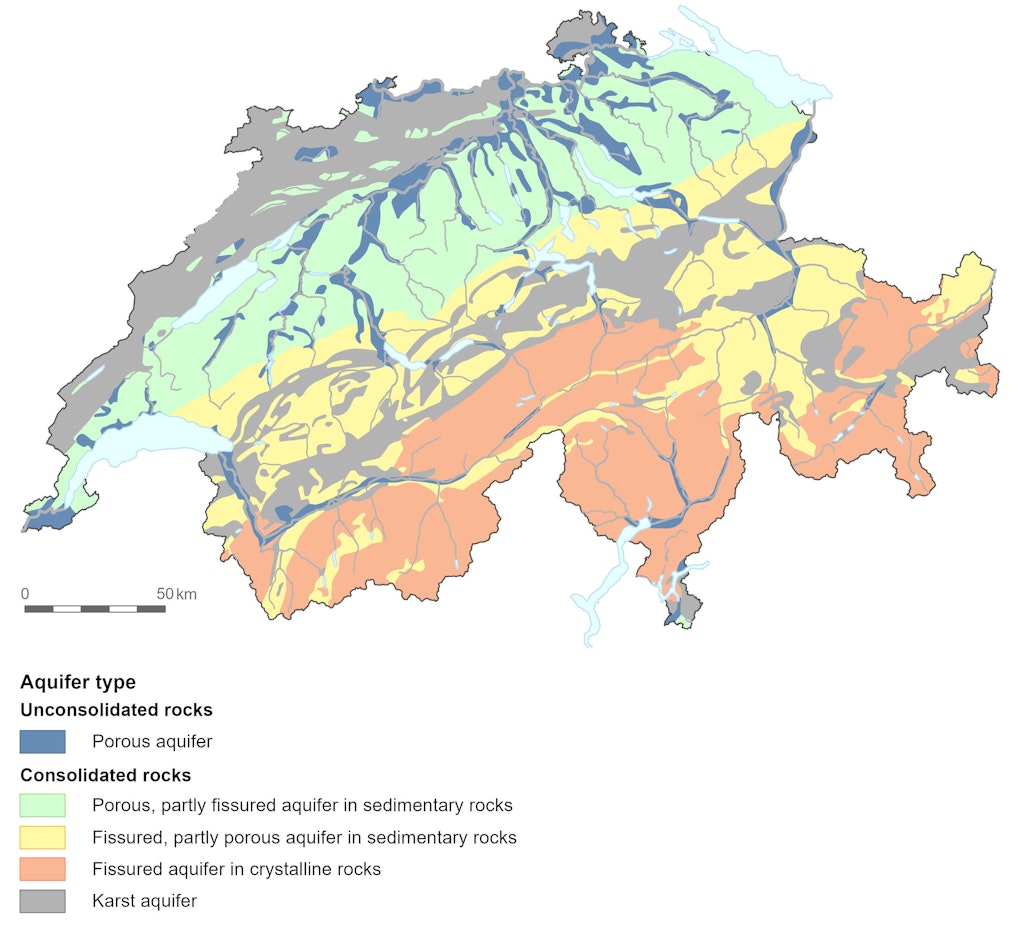
Despite the country’s small size, there are many different types of aquifers in Switzerland. There are three main types: porous, fissured and karst aquifers. Their hydrogeological properties, such as storage capacity and permeability, depend on the properties of the rock.
Aquifers are bodies of rock that have interconnected cavities and can store and conduct groundwater. The aquifer type depends on the type of cavity present in the rock: pores, fissures or karst cavities. Often, an aquifer contains different types of cavities.
During the formation of the Alps, different types of rock came together in a small area in Switzerland. Some of the rocks were subjected to strong tectonic stress, resulting in the formation of fissures. The original properties of a rock, as well as those properties added when the Alps formed, determine the storage capacity and permeability of the aquifer and thus the productivity of the groundwater resource.
Unconsolidated rock
Porous aquifers
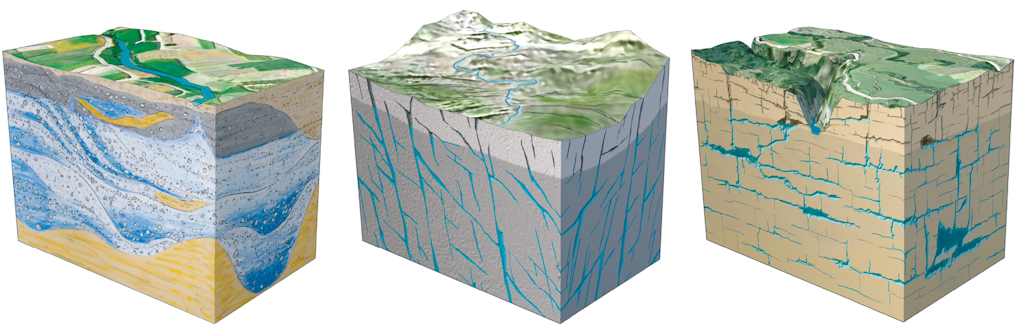
Porous aquifers in unconsolidated rock consist predominantly of gravel and sand. The usable pore space is generally large. Storage capacity, permeability (hydraulic conductivity) and thus also the productivity of the groundwater resource is generally high.
The primary porous aquifers in Switzerland are found in recent alluvial deposits in river valleys on the Swiss Plateau and in large alpine valleys. They lie close to the surface (up to approx. 50 metres deep) and extend locally or regionally. The groundwater resources are thus located in the most densely populated and intensively farmed areas and play an important role in water management.
In northern Switzerland, there are other porous aquifers outside of the valleys, at higher altitudes. These deposits – so-called “Deckenschotter” – are of fluvioglacial origin: they were formed during earlier ice ages when glaciers advanced and melted in the glacier forefield. Their altitude corresponds to the land surface at the time of their formation.
Aquifers of fluvioglacial origin can also occur as deeper aquifers in glacial valleys. A layered structure with several aquifers stacked on top of each other and separated by an impermeable layer such as fine-grained clay and silt or compacted moraine can sometimes be seen today.
Moraines and more recent, coarse-grained deposits of various types such as river debris, slope scree or debris cones can also form porous aquifers. These small aquifers have local significance.

Consolidated rock
Porous aquifers
Porous aquifers also occur in solid (consolidated) rock. In Switzerland, they mainly occur in sandstone on the Swiss Plateau (rocks of the Molasse). When this type of rock formed, the spaces between the grains of sand were filled, cementing the grains together. Over time, this cementation partially dissolves due to ingress and circulation of water. This creates new pore space for groundwater. The sandstone aquifers in Switzerland have a medium storage capacity and permeability. Groundwater resources from porous aquifers are of local to regional significance. Porous aquifers may also contain fissures.
Fissured aquifers
Fissured aquifers are found in crystalline rock such as granite or gneiss and in sedimentary rock consisting of cemented rock debris (clastic sedimentary rock) such as conglomerates and flysch.
Fissures become larger as the result of surface weathering and/or water circulation (solution) or when the pressure on the rock is released as glacier ice melts. In crystalline rock, chemical dissolution of the rock plays a minor role, and fissures are usually only sufficiently pronounced in the uppermost few hundred metres for an aquifer to form. More intensive fissuring occurs in zones with instabilities such as deep landslides.
Fissured aquifers are characterised by medium to low-storage capacities and permeabilities, depending on the frequency and size of the fissures. The groundwater productivity is thus also medium to low, but higher in zones with slope instabilities. However, it is only possible to generalise the hydrogeological properties to a limited extent since these aquifers vary greatly, and limited data is available.
Sedimentary rocks often contain both fissure and pore cavities. The rock types found in the Alpine foothills and the Alps experienced strong tectonic deformation during the formation of the Alps, and so fissure cavities predominate. The sedimentary rocks in the Swiss Plateau and the Jura were subjected to little tectonic stress, so in these regions pore cavities predominate. See also the paragraph above on porous aquifers in consolidated rock.
Karst aquifers
Karst aquifers form in limestone, dolomite and evaporite rocks (gypsum, anhydrite, and to a lesser extent salt) found in the Jura, the northern and southern Alpine foothills and the Alps. They contain substantial amounts of groundwater and in some cases extend over large areas.
Karst cavities tend to develop along tectonic faults and strata boundaries in the rock. The constant contact of weakly acidic water (carbonic acid, H2CO3) with the rock – at first near the surface, then deeper and deeper – gradually dissolves the carbonate and evaporite minerals. This can result in cavities of a far greater size than fissure cavities. The storage capacity and permeability in karst aquifers are thus medium to high. Flow velocity may be high in large karst cavities. As a result, spring discharge rates in karst areas fluctuate, as the groundwater flows rapidly through the rock once it infiltrates the subsurface.