

Waste policy
The Swiss waste management economy is a well-functioning system involving public and private stakeholders. This system is one component in a sustainable and comprehensive resources policy. Raw materials are limited and expensive, and for this reason, any material cycles that are still open must be closed. This is the goal that has been set within the context of resource conservation and the circular economy.
In response to a parliamentary initiative on promoting the Swiss circular economy (20.433), Parliament adopted in March 2024 a revision of the Environmental Protection Act (EPA), the Energy Act (EnA) and the Public Procurement Act (PPA). In the context of this legislative revision, a new chapter will be created in the Environmental Protection Act on protecting natural resources and improving the circular economy. The issue will thus assume greater weight in environment law.
On 13 November 2024, the Federal Council decided that the larger part of the new legislative basis would pass into law on 1 January 2025. The provisions on littering (Art. 31b para. 7 and Art. 61 para. 4 EPA), on the municipal waste monopoly (Art. 31b paras 4-6 EPA) and on the recognition of private sector organisations (Art. 32ater EPA) will enter into force at a later date.
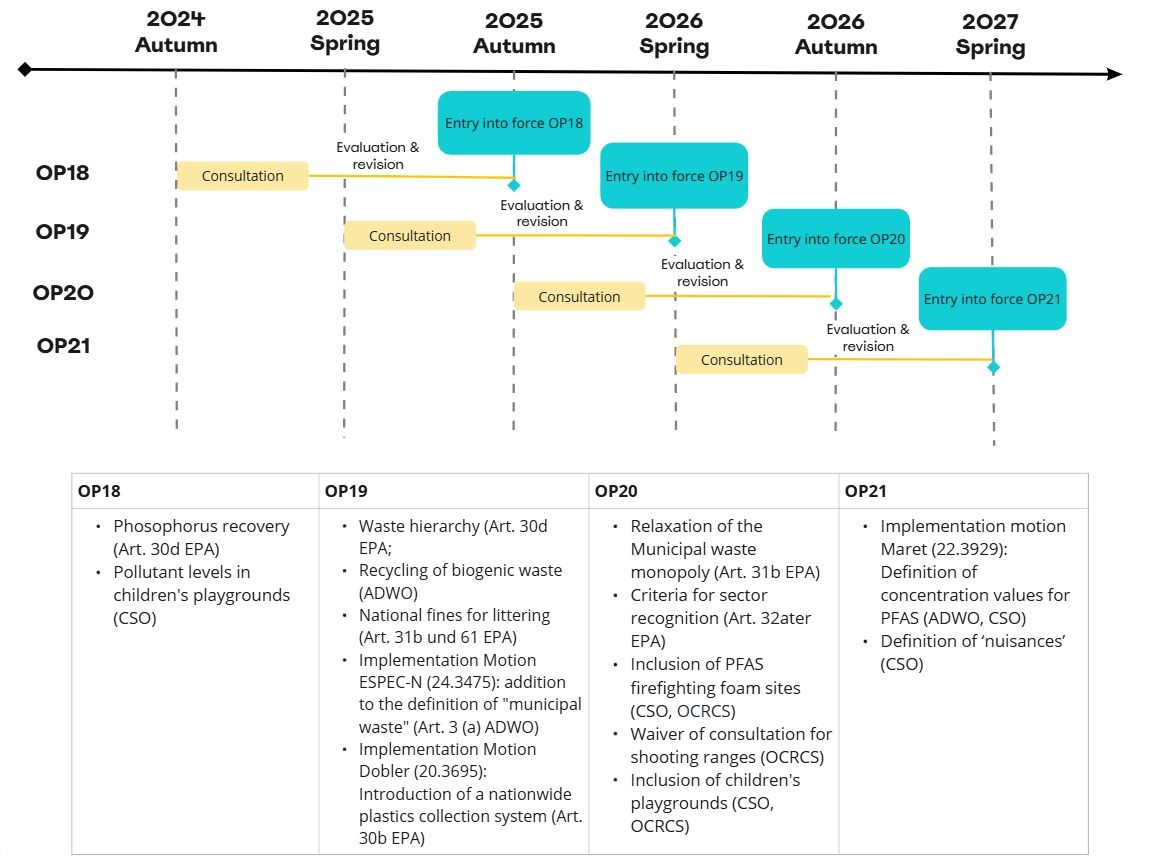
The revised ordinances will be put out for consultation in a staggered manner. The consultation on the provisions relating to the relaxation of the municipal waste monopoly and the recognition of private sector organisations is planned for spring 2026. The implementation of the Dobler motion (20.3695) and the introduction of a standardised nationwide collection scheme for plastics will take place with the revision of the Packaging Ordinance (VerpV). The changes under Ordinance Package 19 (OP19) are expected to come into force mid-2026, while those under Ordinance Package 20 (OP20) are expected to come into force at the end of 2026.
The Maret motion (22.3929) calls for the introduction of specific limit values for PFAS in relation to waste, soil contamination and water protection. This will be implemented in Ordinance Package 21 (OP21). The same package of ordinances also clarifies the term ‘harmful effects’ in the Contaminated Sites Ordinance. The relevant amendments to the ordinances will be put out for consultation in the summer of 2026 and are expected to come into force mid-2027.
The following timetable is planned for the consultations on amendments to the various ordinances (as of August 2026, subject to change):
%20August%202026%20ZIR.jpg?w=1024&auto=format)