

Wolves
Lone wolves have been migrating to Switzerland since 1995. In 2012, the first pack formed. The return of this large predator is seen as a success for species conservation – and at the same time presents society with new challenges.
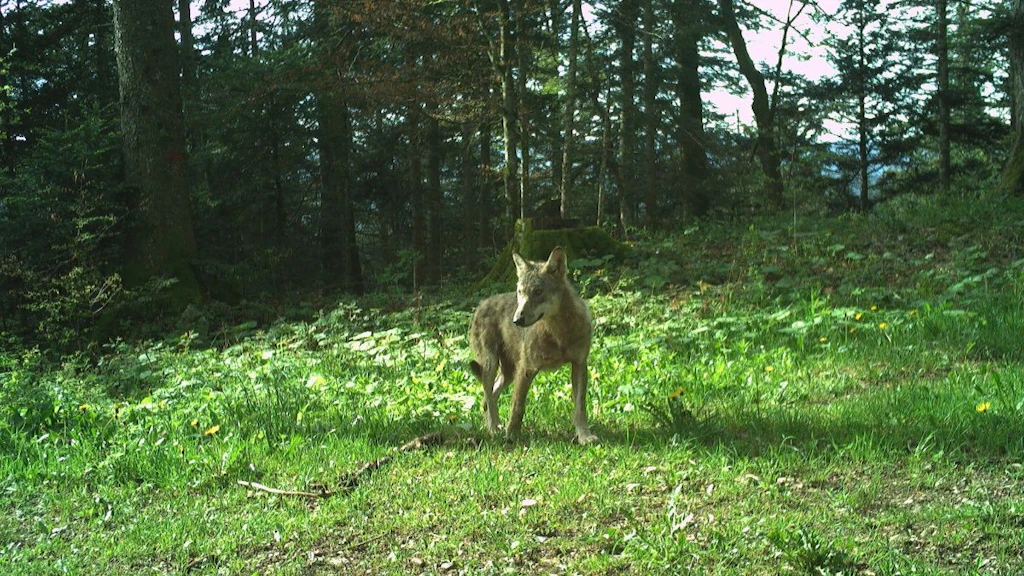
Wolves migrated to Switzerland from Italy and France. Since the first pack formed at Calanda (GR) in 2012, the wolf population has grown steadily and continues to expand. After the 2025/26 preventive culling period ended on 1 February 2026, there were 350 wolves in Switzerland, spread out across 30 packs entirely on Swiss territory and 10 other cross-border packs. In addition, there are numerous lone wolves. While packs tend to be concentrated in specific regions, lone wolves can, in principle, be found throughout Switzerland..
Conflicts with local farmers
Wolves are protected animals, and Switzerland is obliged to safeguard the long-term viability of the wolf population. Wolves find a rich supply of wild game in Switzerland; they feed mainly on roe deer, mountain goats and red deer. Conflicts with local farmers can arise in those areas where livestock is kept. In such cases, livestock protection measures are essential – both on agricultural land and in summer grazing areas. These measures ensure that livestock are not easy prey for wolves. The federal government provides around CHF 10 million per year to the agricultural sector for livestock protection.
Another measure to stave off potential conflict is to pay compensation for livestock killed by wolves (see section Compensation paid for wolf attacks (since 1999). If preventive and accompanying measures prove insufficient, the wolf population may be culled under certain conditions.
Livestock protection
The Confederation coordinates and supports the livestock protection measures implemented by the cantons. These measures help to protect farm animals from large predators. Cantons may apply for subsidies for livestock protection measures: these include, for example, the electrification of fences, the purchase of pasture netting for night pens, materials to deter wolves, renting mobile shelters or using livestock guardian dogs. The Confederation subsidises 80% of cantonal costs for livestock protection measures.
Compensation paid for wolf attacks (since 1999)
The following figures show the amount of compensation paid by the federal government for livestock attacked by wolves. The federal government pays 80% of the costs, provided the cantons cover the remainder. Compensation is paid by the federal government annually in December. Claims are considered for damage occurring from 1 November of the previous year to 31 October of the current year. Compensation is paid not only for animals killed by wolves, but also for those injured and treated by a vet. The Confederation and the cantons also share the costs of disposing of dead animals.
International cooperation
Wolves roam across national borders, which is why cooperation between the Alpine countries (Switzerland, France, Germany, Italy, Liechtenstein, Austria and Slovenia) is important. To this end, officials from these countries meet together on a regular basis.