


This version is for browsers with a low level of support for CSS.
Home Content Area
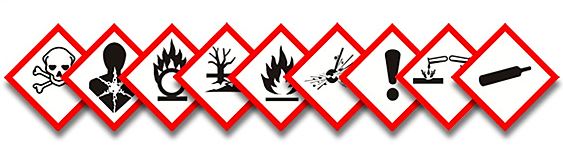
The GHS is an international set of rules for the classification, labelling and packaging of chemicals, which must be implemented in national law. In Switzerland the implementation is taking place in a stepwise fashion through the amendment of existing ordinances. Since 20 January 2009, chemicals for applications in trade and industry in Switzerland may be classified and labelled according to the GHS.
At the 1992 UN Conference in Rio de Janeiro on environment and development, it was agreed to develop a Globally Harmonized System of Classification and Labelling of Chemicals (GHS). The GHS contains, in particular:
At the 2002 UN Summit 2002 it was recommended that the GHS should be integrated into national or regional law by 2008.
On 20 January 2009, the EU brought into force Regulation (EC) No. 1272/2008 of the European Parliament and of the Council of 16 December 2008 on the classification, labelling and packaging of substances and mixtures, also known as the CLP Regulation.
The CLP Regulation requires producers, importers and downstream users to classify, and suppliers to label and package, their substances and mixtures according to the new rules before placing them on the market. The deadline for proposing provisional classifications for pure substances is 1 December 2010. The deadline for classifying mixtures (i.e. preparations) is 1 June 2015.
The CLP Regulation will gradually replace the Dangerous Substances Directive 67/548/EEC and the Dangerous Preparations Directive 1999/45/EC. These two Directives will be repealed by the CLP Regulation from 1 June 2015.
By amending the Chemicals Ordinance (ChemO) on 14 January 2009 the Federal Council completed the first step in the introduction of the GHS in Switzerland. Since 1 February 2009, chemicals (substances and preparations) in Switzerland may be placed on the marker for trade and industry applications if they have been classified, labelled and packaged according to the rules of the CLP Regulation. In this way, Switzerland avoids creating trade barriers in the cross-border transport of chemicals. The existing high level of protection in the handling of chemical products remains.
In the long term it can be expected that the worldwide introduction of the GHS will facilitate world trade in chemical products and improve communication about the hazardous properties of chemicals.
After market access for chemicals labelled and packaged according to the GHS/CLP has been ensured in Switzerland, there will be a need for further harmonisation of law at the level of ordinances, in order to achieve the goal of introducing the GHS in Switzerland at the same time as in the EU, and with the same contents.
In future, permission to place on the market chemicals that have been classified, labelled and packaged according to the GHS/CLP should be extended to products for the general public, and the transitional periods for adjustment to the GHS/CLP for substances and preparations should be subject to binding regulations.
Finally, the so-called follow-up obligations, i.e. statutory provisions based on the classification or labelling of substances and preparations, must also be harmonised with provisions of the GHS/CLP system. These include rules on dispensing chemicals, reporting requirements, and rules covering consumer protection (e.g. for cosmetics, toys) and workplace safety, as well as thresholds for risk assessment in accident prevention.
End Content Area