

Hydrological scenarios: Key messages
Climate change will greatly affect water availability over the course of the year. The Hydro-CH2018 hydrological scenarios show that, at certain times and in certain regions, this vital resource will become so scarce or so warm that humans will have to curb their activities and nature will suffer. With climate change mitigation, the changes will be much smaller, meaning that such mitigation is worth the effort. Systematic protection of waters as well as careful planning and management will enable the challenges to be dealt with more effectively.
Changes in runoff
The contribution of meltwater from snow and ice to runoff will continue to decrease, leading to changes in the seasonal distribution of runoff. In the future, Swiss watercourses will carry more water in winter and less in summer, although the total annual runoff will only decrease slightly.

Water shortages in summer
In the future, rivers and streams will carry less water in summer than they do today. Dry periods will also become longer and more frequent. During such extreme events, temporary water shortages may occur in some regions.

Growing hazard potential
More intense heavy rainfall will lead to more localised flooding and surface runoff. There is also evidence to suggest that large-scale floods will become more common. In addition, warming will cause glaciers to melt and will destabilise the frozen subsoil in high-altitude areas.

Aquatic life at risk
Intensive use and hard engineering of water bodies as well as pollutant input are affecting many animals and plants that live in and around water. Climate change is placing added pressure on the water bodies due to higher water temperatures and changes in runoff. This will lead to a decline in biodiversity in and around waterbodies.

Adjusting usage, protecting water bodies
Ecologically intact water bodies will be better able to cope with climate change and meet the diverse demands of society. It is therefore important to protect water resources from excessive abstraction and from contamination by pollutants and fertilisers. In addition, streams, rivers, lakes and groundwater must be kept in, or restored to, a state that is as natural as possible.
A look behind the scenarios
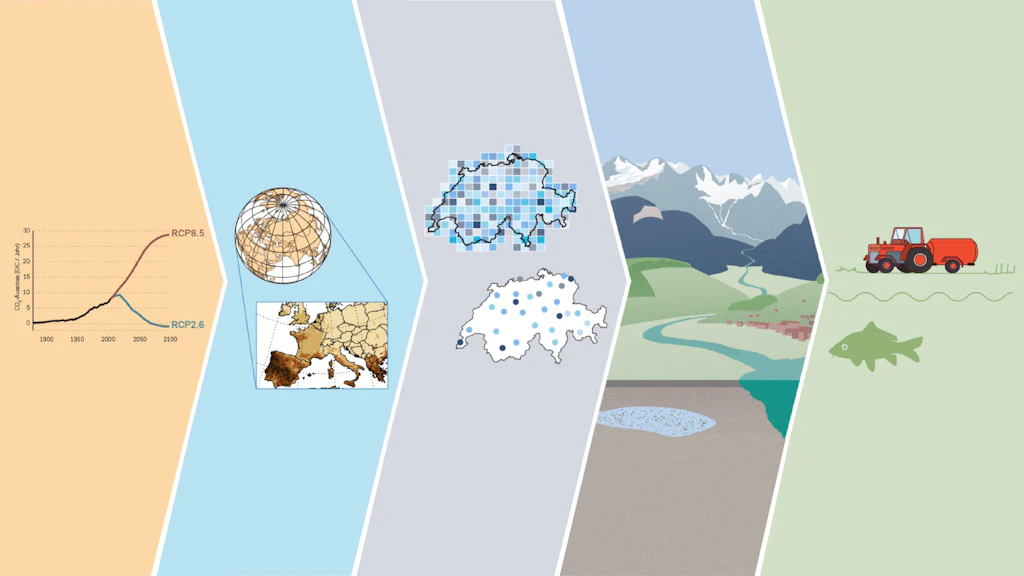
The Hydro-CH2018 hydrological scenarios are based on model calculations by leading Swiss research institutions and take into account the latest climate scenarios.