

TFA – A persistent pollutant
Trifluoroacetic acid (TFA) is a highly mobile yet extremely stable substance. Itself a ‘forever chemical’, it is the smallest of the PFAS molecules produced when larger PFAS degrade. These might be refrigerants leaked from air conditioning systems and heat pumps, propellants used in aerosol cans and foams, or plant protection products used in agriculture.
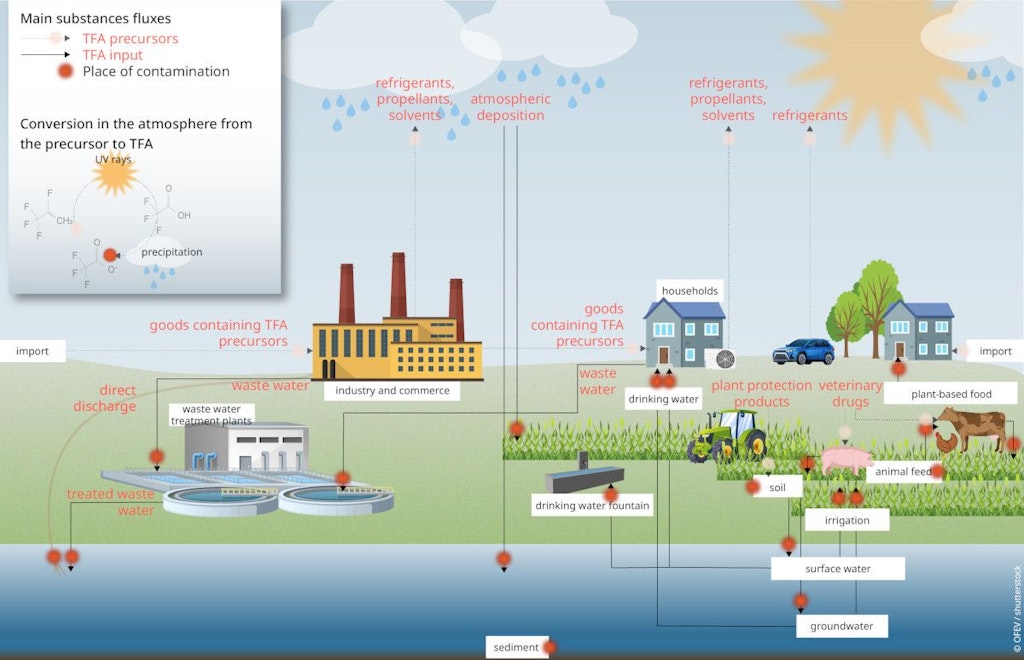
TFA dissolves easily in water and is not biodegradable, and so it is now found in rainwater, rivers, lakes and groundwater all over the world. Once released, it remains in the environment for a very long time.
How does TFA enter the environment?
When used, refrigerants and propellants are released into the air, where they are broken down by sunlight. This produces TFA, which is transported into the soil by rainfall and washed into lakes and rivers. TFA is also produced when some of the plant protection products used on agricultural crops break down.
Where is TFA found?
- In water: precipitation, lakes, rivers, groundwater and drinking water
- In the soil: particularly on agricultural land
- In plants: TFA is absorbed through the roots
- In animals and humans: TFA can accumulate in organisms.
Learn more about TFA from the FOEN
Reducing TFA in the environment
The Federal Council has already decided to impose restrictions on TFA-forming refrigerants and propellants in revision of the Chemical Risk Reduction Ordinance (ORRChem). The potential of plant protection products to break down into TFA will be assessed when active substance authorisation is renewed in the EU. Further regulations are currently being discussed as part of efforts to introduce a comprehensive ban on PFASs in the European Union. The Federal Council will consider adopting into Swiss legislation any measures decided on by the EU.
Furthermore, the Federal Council intends to launch an action plan to reduce the impact of long-lasting chemicals on people and the environment – in particular PFAS, which include TFA. One objective of this measure is to strengthen cooperation between the Confederation and the cantons. On 19 December 2025 the Federal Council approved the report on this issue produced in response to the Moser Postulate 22.458