

TFA in precipitation
Trifluoroacetic acid (TFA) is found in precipitation throughout Switzerland. Concentrations are significantly higher in summer than during the rest of the year. A large proportion of TFA in precipitation originates from precursor compounds, which are broken down into TFA in the atmosphere when exposed to UV radiation. On average, the concentration of TFA in precipitation is around 0.6 microgrammes per litre (µg/l). This is a four-fold increase since the 1980s, according to a comparison of precipitation samples from 2020 to 2023 with older samples from the archive. Each year, 25 tonnes of TFA fall on Switzerland in precipitation; this equates to 0.6 kilograms per square kilometre, or around 4 grams over an area the size of football pitch.
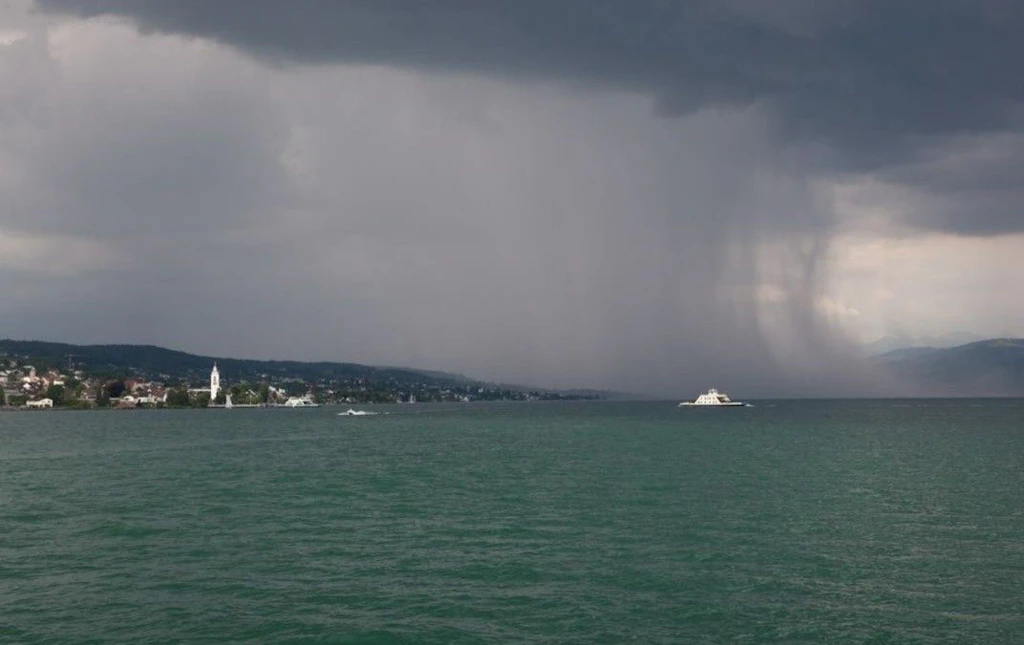
TFA originates in various sources and can also be detected in precipitation.
Water sample analyses 2020–2023
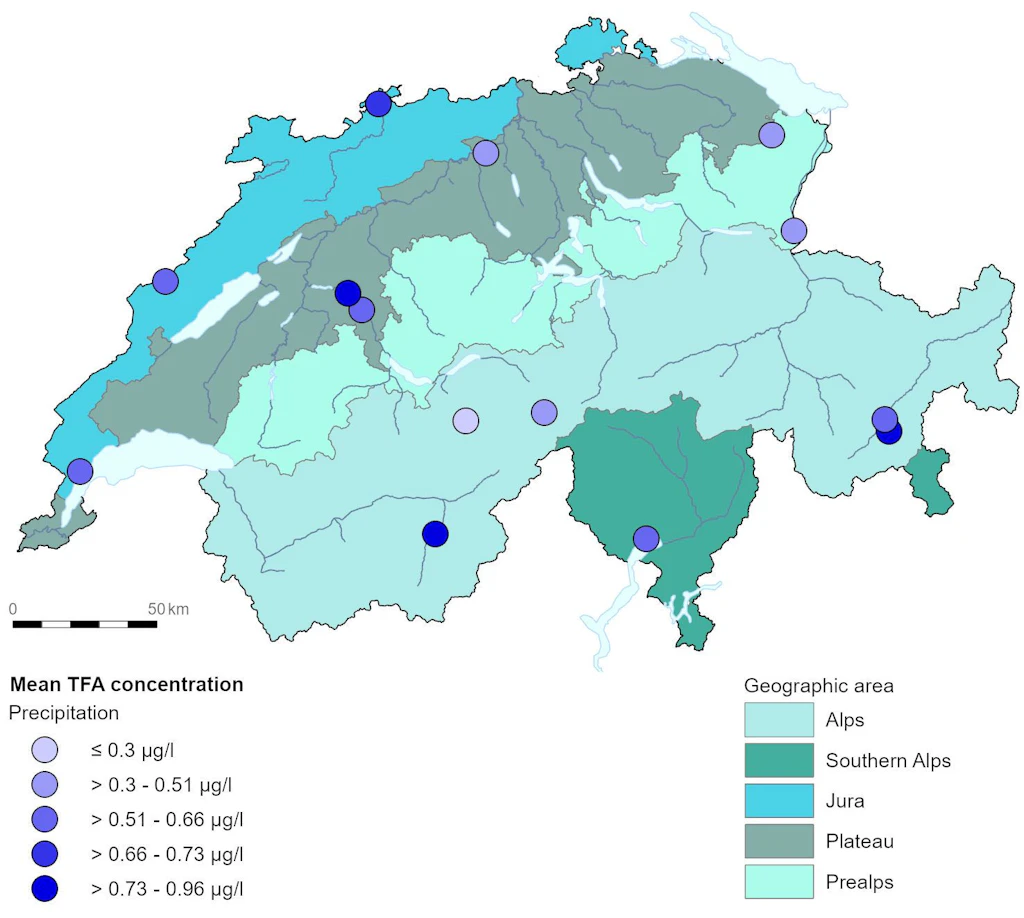
Water samples from the monitoring network for stable isotopes (NAQUA-ISOT) and several other sites were analysed for TFA in lab tests. The samples were collected between 2020 and 2023 from 14 stations in the main river basins in Switzerland, covering a range of topographical areas (see map below).
Key findings:
- The TFA concentrations in precipitation ranged from 0.04 µg/l to 5.7 µg/l (averaging 0.6 µg/l).
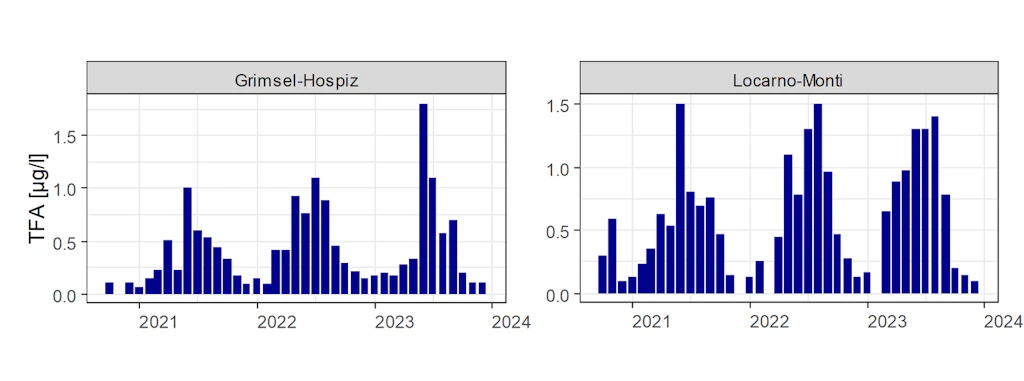
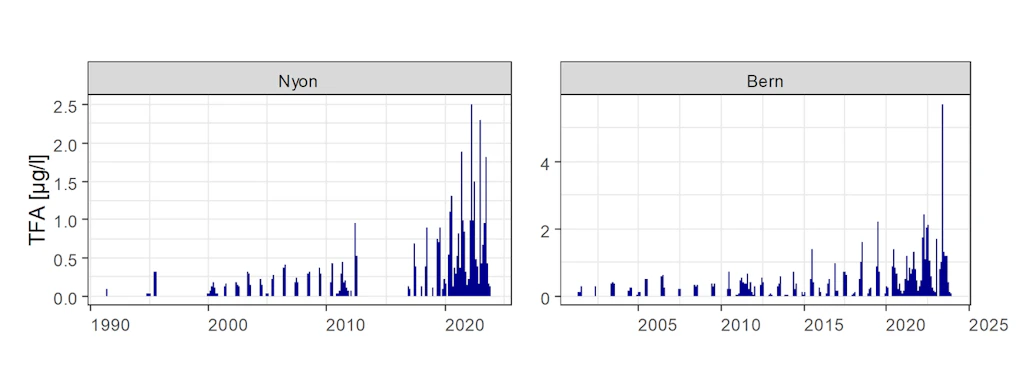
- TFA concentrations followed an annual cycle, with the highest levels in summer and lower levels in winter (see graphs below). This is due to the faster breakdown of the precursor compounds in the atmosphere during the summer.
- Similar concentrations of TFA in precipitation are found in Switzerland and in Germany. This is because air masses containing the precursors of TFA are exchanged over large areas.
- The topography of the terrain influences where precipitation falls and how heavy it is. Depending on weather conditions and prevailing air currents, this results in regional and local variations in TFA concentrations in precipitation. The lowest TFA concentrations (0.3 µg/l) were recorded on the Jungfraujoch, whilst the highest (1 µg/l) were recorded in the city of Bern.
Analysis of archived samples since 1987
Archive samples from the same monitoring network (precipitation, NAQUA-ISOT) dating back to the 1980s were also analysed for TFA.
An article on this topic was published in issue 1/2023 of the FOEN magazine die umwelt: Das Gedächtnis des Wassers anzapfen (p. 41 ff.).
The concentrations in the archived samples were compared with current data. The comparison shows that TFA concentrations in precipitation have increased four-fold since the 1980s (see graphs).
TFA in precipitation
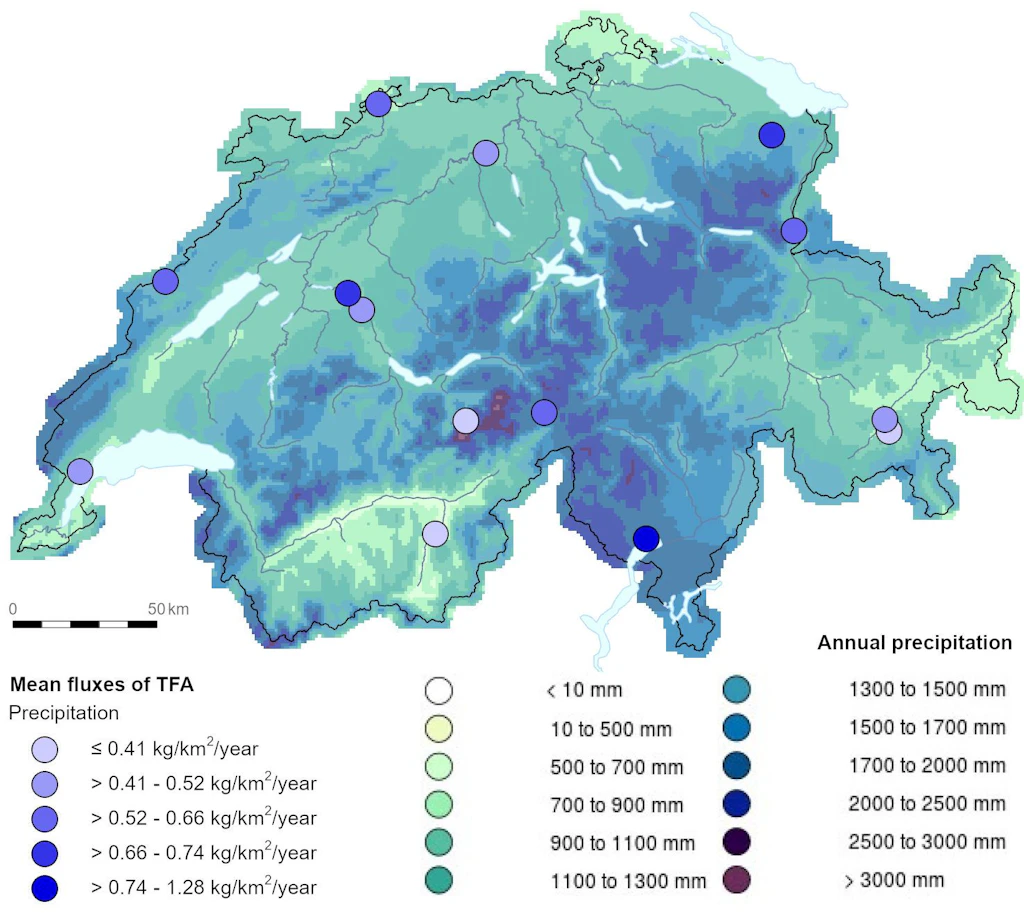
Measurements indicate that the annual amount of TFA in precipitation across Switzerland is an estimated 25 tonnes – equal to 0.6 kilograms per square kilometre per year, or roughly 4 grams over an area the size of a football pitch. High TFA concentrations in precipitation do not necessarily mean high deposition in a particular place, as the amount of precipitation is also considered when deposition is calculated. For example, although concentrations in Locarno were only slightly above the Swiss average, the local annual deposition of 1.3 kg/km2 was the highest of all the stations monitored, as rainfall there is higher than at other stations, particularly in summer, when TFA concentrations are at their highest. The following map shows the TFA depositions at the stations monitored:
TFA has also been detected in surface waters and groundwater:
The Swiss Federal Laboratories for Materials Science and Technology (Empa), in collaboration with the Federal Office for the Environment (FOEN) and the University of Bern, investigated how TFA is formed in the atmosphere and how it enters lakes and rivers via precipitation.