

TFA – emission sources
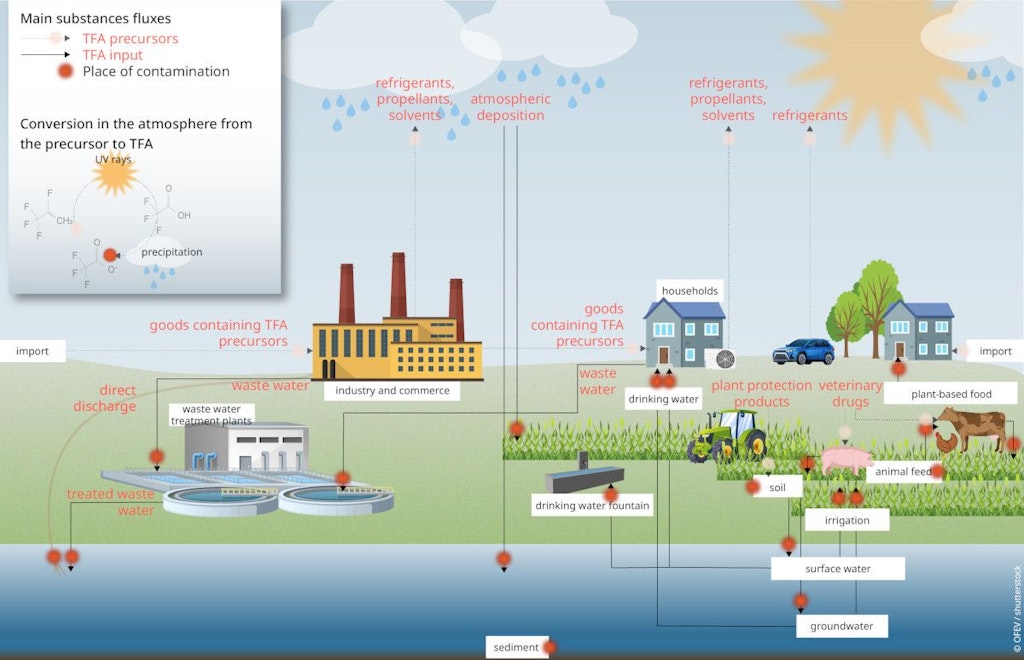
Trifluoroacetic acid/trifluoroacetate (TFA) enters the environment via various pathways: from gaseous refrigerants and propellants from foams and aerosol cans, through the use of pesticides and veterinary drugs and from industrial sources and wastewater treatment plants.
Refrigerants and propellants
TFA is formed in the atmosphere as a degradation product of anthropogenic fluorinated gases. These include, in particular, hydrochlorofluorocarbons (HCFCs), hydrofluorocarbons (HFCs), and hydrofluoroolefins (HFOs). Emissions from their use cause these gases to enter the atmosphere, and the resulting TFA is deposited on the Earth's surface and in water bodies through precipitation. Due to its chemical composition, TFA belongs to the group of per- and polyfluoroalkyl substances (PFASs).
The gases mentioned are used in many areas of application. They are used in particular as refrigerants in refrigeration systems and heat pumps. Other areas of application include use as industrial solvents for metal degreasing and cleaning, and as propellants in foams or aerosol sprays.
HFOs are particularly relevant for TFA formation in the atmosphere. They are currently the most important and steadily increasing source of TFA, as they are considered substitutes for climate-damaging HFCs, for example in vehicle air conditioning systems, refrigeration systems and heat pumps. Due to their shorter lifetime in the air (in the order of days to weeks), they can contribute significantly to TFA formation. Depending on wind currents, some of them can also be distributed over large areas beyond national borders.
Plant protection products
More than two dozen plant active ingredients in plant protection products are currently approved that contain at least one CF3-group in their molecular structure and thus have the potential to degrade into TFA. These are mainly herbicides and fungicides, as well as a few insecticides. They are used in field and vegetable cultivation, fruit growing and viticulture, as well as for ornamental plants and, in some cases, in forest nurseries. In 2022, a total of more than 40 tons of these active ingredients were used. Flufenacet and fluazinam were used in the largest quantities throughout Switzerland, with up to 10 tons per year each. Flufenacet was approved as a herbicide for use in the cultivation of corn, cereals, and potatoes, among other crops, until May 2025 and may continue to be used until 1 January 2027. Fluazinam is used in potato cultivation and is also approved for use in viticulture and for various ornamental plants.
Industrial sources and wastewater treatment plants
TFA is also used in the chemical industry, including as a solvent in the manufacture of medical and cosmetic raw materials. It enters wastewater treatment plants with the wastewater. These plants cannot remove TFA, so it enters surface waters from there.
Contribution of various entry routes to TFA in soils and waters
A recent study determined the concentrations of TFA in Swiss precipitation (TFA in precipitation) and in rivers and lakes and estimated the contributions of different emission sources.
The measured TFA concentrations in precipitation between 2021 and 2023 ranged from 0.30 to 0.96 μg per litre, which corresponds to an increase of at least a factor of 4 over the last three decades. This results in an average TFA deposition rate of 0.59 kg per km2 and per year and a total TFA input from atmospheric sources in Switzerland of 24.5 tons per year. In comparison, TFA inputs from plant protection products are estimated at 2.9 to 11.8 tons per year. No quantitative information is currently available on TFA emissions from veterinary drugs; however, their contribution is likely to be considerably smaller than that of the aforementioned emission sources.
In terms of the contamination of cropland and the underlying groundwater, the input of TFA from plant protection products, at an average of 1.7 kg per km2 and per year, significantly exceeds the input via precipitation (0,59 kg per km2 and per year).
Input from industrial sources is currently being investigated.