Pesticides in groundwater
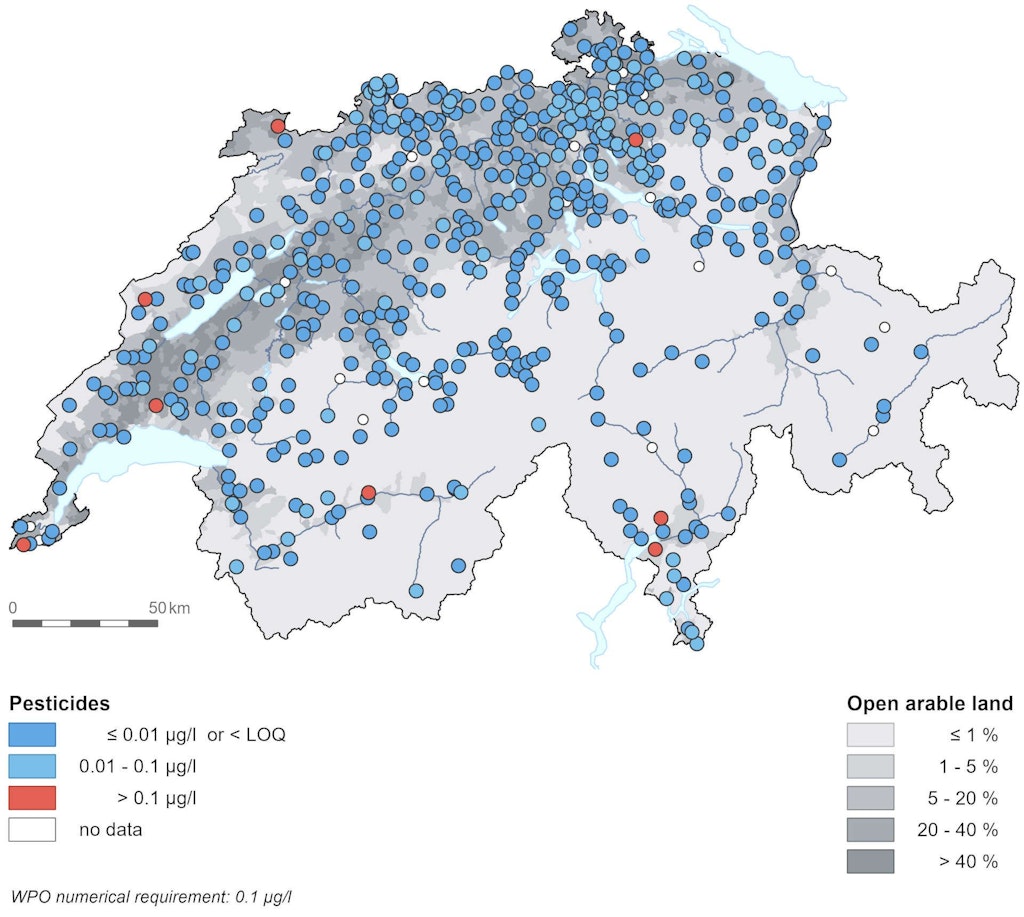
Pesticides exceed the limit value of 0.1 micrograms per litre at 1 to 2% of monitoring sites every year. In addition, pesticide degradation products (known as metabolites) occur in concentrations of more than 0.1 micrograms per litre at one in three groundwater monitoring sites across Switzerland. Metabolites of pesticides significantly impair the quality of groundwater, particularly on the Swiss Plateau.
Under the Waters Protection Ordinance (WPO), groundwater should generally not contain any persistent synthetic substances. For groundwater used for drinking water or intended for such use, there is also a limit value ('numerical requirement') of 0.1 micrograms per litre (µg/l) for pesticides. In addition, the groundwater – after basic treatment, where appropriate – must meet the requirements of legislation on foodstuffs. This legislation also prescribes a maximum value of 0.1 µg/l for pesticide metabolites classified as relevant for drinking water in the authorisation procedure.
Pesticides exceed the limit value at 1 to 2% of the NAQUA National Groundwater Monitoring sites per year. This percentage has remained largely unchanged for more than 10 years. In recent years, elevated concentrations were mostly due to the herbicide bentazone. Groundwater resources in karst areas of the Jura are particularly susceptible to pesticide pollution. There, these substances can exceed the limit value for a short time, but sometimes substantially.
Metabolites are widespread
In intensively used agricultural areas, metabolites are widespread and are regularly detected at concentrations greater than 0.1 μg/l. On the Swiss Plateau, metabolites exceed the value of 0.1 μg/l at about 60% of monitoring sites. Nationwide, every third NAQUA monitoring site is affected.
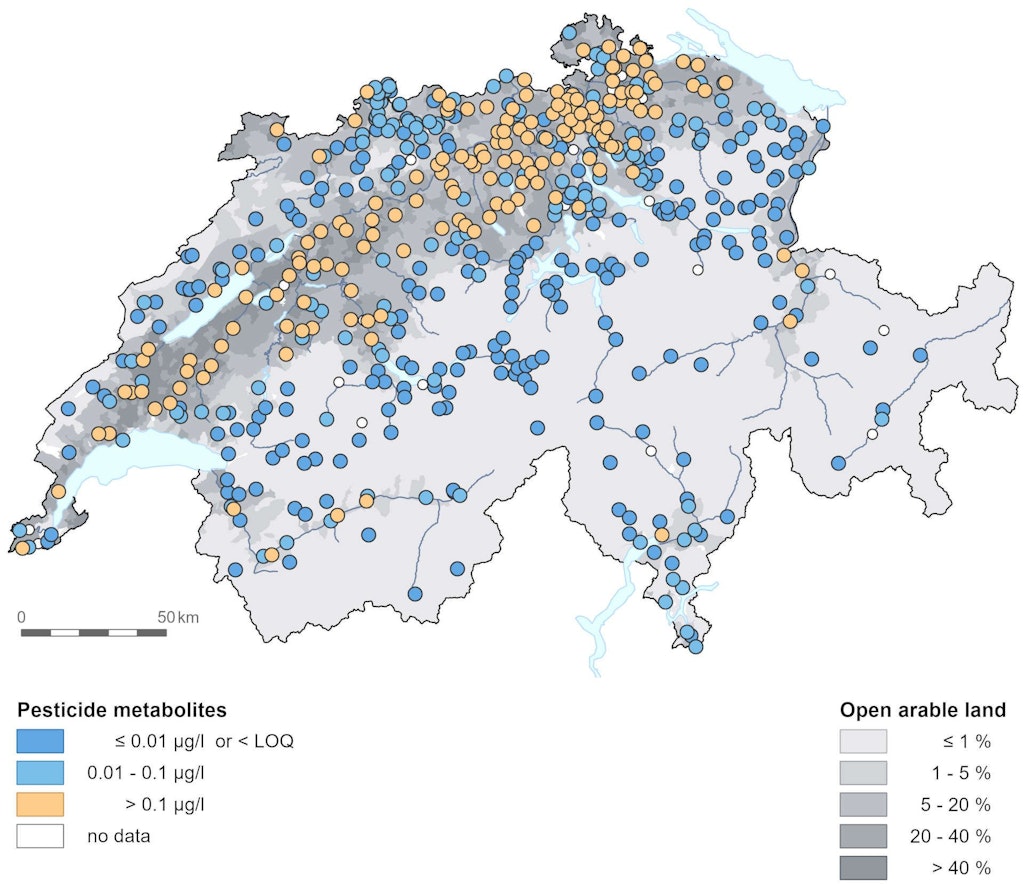
A total of 24 metabolites of 12 active substances currently exceed the value of 0.1 μg/l.
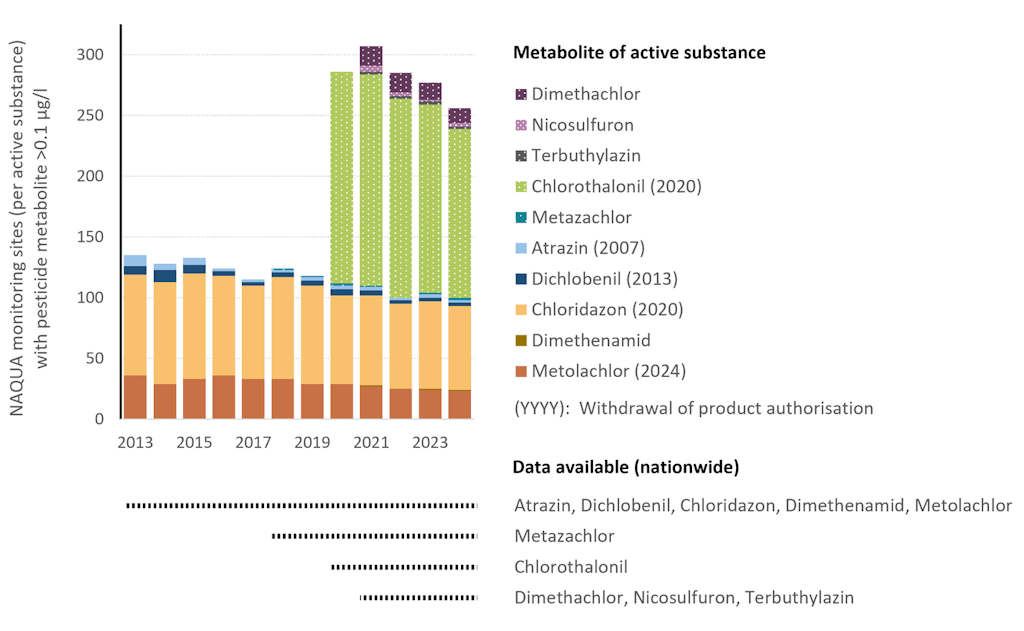
Metabolites of the fungicide chlorothalonil are particularly widespread in groundwater. In arable farming areas, they exceed the value of 0.1μg/l at more than 70% of the monitoring sites. Throughout the country, more than one in four monitoring sites is affected. Chlorothalonil has been banned since 2020 and concentrations are starting to decline.
Metabolites of the herbicides chloridazon and metolachlor also exceed the value of 0.1 μg/l both repeatedly and widely. The metabolites of chloridazon occurred at elevated concentrations at up to 14% of the monitoring sites per year over the last 5 years, the metabolites of metolachlor were found at about 5% of the monitoring sites. The approval for chloridazon was withdrawn in 2020, and the approval for metolachlor was withdrawn in 2024.
The metabolites of dimethachlor, for which a nationwide analysis was launched in 2021, also affect groundwater quality at numerous monitoring sites. The metabolites exceed the value of 0.1 μg/l at 2% of the monitoring sites at a national scale. Since 2023, dimethachlor may only be used in exceptional cases, i.e., with special permission, by farmers that receive direct payments as part of the ecological performance certificate.